Pre-Congress Organizations and Evolution of Indian National Congress (INC)

Explore the early political organizations before the formation of the Indian National Congress (INC) and trace the evolution, achievements, and criticism of the INC from 1885 onwards.

THEIASHUB
Get an Instant Call Back from Our Expert Mentors Now!
+91

Before the establishment of the Indian National Congress (INC) in 1885, India witnessed the emergence of several organizations and movements that laid the groundwork for the nationalist movement. 


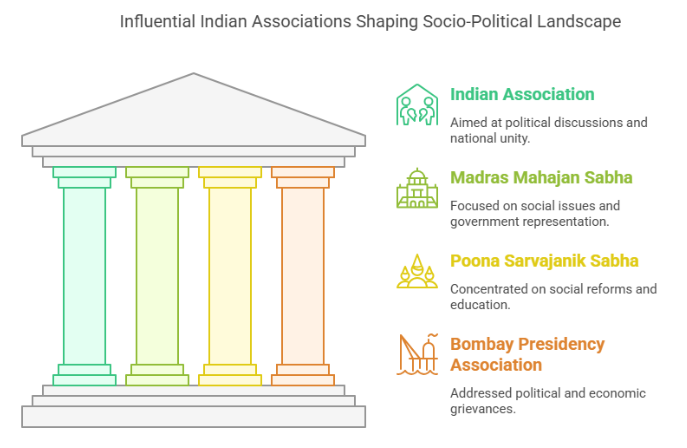
Indian Association (1876)

  • Founded by Surendranath Banerjee and Ananda Mohan Bose in Calcutta, the Indian Association aimed to provide a platform for political discussions, promote national unity, and work towards political reforms.

Madras Mahajan Sabha (1884)

  • Established by M. Veeraraghavachariar and G. Subramania Iyer, the Madras Mahajan Sabha sought to address social and political issues, create awareness among the masses, and advocate for civil liberties, education, and representation in the government.

Poona Sarvajanik Sabha (1870)

  • Founded by Mahadev Govind Ranade and others, the Poona Sarvajanik Sabha focused on social reforms, education, and improving the conditions of the lower castes.

Bombay Presidency Association (1885)

  • Led by Pherozeshah Mehta, the Bombay Presidency Association was formed to address political and economic grievances in the Bombay Presidency. It emphasized constitutional methods and worked towards increasing Indian representation in governance.

Anjuman-e-Islam (1874)

  • Founded by Badruddin Tyabji, Anjuman-e-Islam aimed to promote education and social welfare among the Muslim community. It later played an active role in the national movement.


Formation and Evolution of the Indian National Congress

The formation of the Indian National Congress (INC) in 1885 marked a significant milestone in India's struggle for independence.
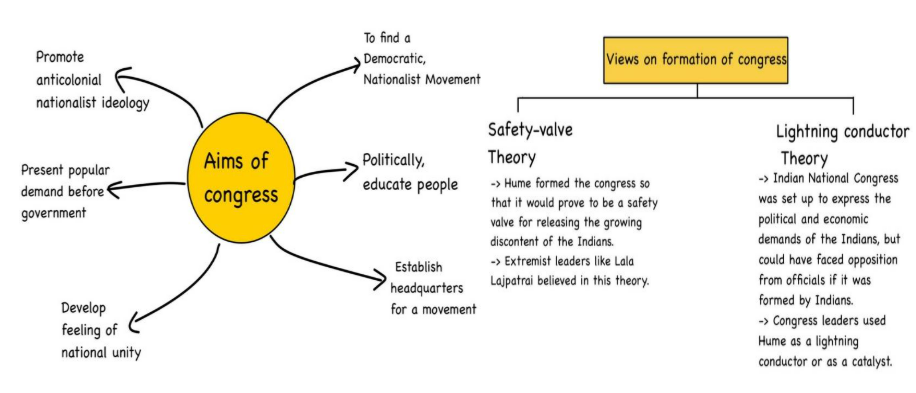

  • Early leaders like Allan Octavian Hume, Dadabhai Naoroji, and Dinshaw Wacha played key roles in shaping the Congress's objectives.
  • Over the years, the Congress evolved into a more organized political entity, attracting leaders from different regions and backgrounds.
  • It expanded its focus to include demands for self-governance and political independence from British rule.
  • Leaders like Mahatma Gandhi, Jawaharlal Nehru, Sardar Patel, and others led the Congress in its struggle for freedom


CHALLENGES AND CRITICISM OF INC

  • Moderate Approach: Critics felt the INC's cautious and incremental approach hindered progress toward nationalist goals.
  • Limited Social Base: Initially representing the educated elite and middle class, the INC was criticized for not effectively addressing the concerns of the masses, especially peasants and workers.
  • Limited Success: The INC struggled to gain widespread support and achieve its objectives, partly due to British government resistance.
  • Internal Divisions: Internal conflicts between moderate and radical factions caused tensions within the organization.
  • Repression by the British: The British government's repression and restrictions, including arrests and bans on activities, hindered the INC's effectiveness.
  • Lack of Mass Mobilization: Critics argued the INC failed to effectively mobilize the masses, primarily due to its limited social base and organizational structure.
  • Limited Success in Reforms: While advocating for reforms and Indian representation in governance, the INC's achievements were seen as insufficient.
  • Regional Imbalance: Initially focused on Bombay, Calcutta, and Madras, the INC was criticized for not adequately representing all regions of India.
  • Response to Social Issues: Criticism arose over the INC's perceived lack of focus on social issues like caste discrimination and women's rights.
  • Lack of Concrete Achievements: Some critics doubted the INC's impact, questioning its tangible achievements and influence on British policies or Indian lives.


UPSC QEP 2026 Batch 5 - English
Buy now View Details
Submit Your Details to Learn More
I agree to give my consent to receive updates through SMS/Email & WhatsApp*.

NEEV GS + CSAT Foundation 2026/27
Buy now View Details


Join theIAShub’s Mains Answer Writing Program

Refine your answer writing skills and elevate your UPSC preparation with personalized support and expert feedback.

Fill out the form to get started with the program or any other enquiries !

I agree to give my consent to receive updates through SMS/Email & WhatsApp*.

Best IAS Coaching In Delhi, UPSC Online & Offline Classes by IAShub

Are you dreaming of becoming an IAS officer? Then, IAShub can be your best guide. It is one of the Best IAS Coaching in Delhi. Many students who want to clear the UPSC exam join IAShub for learning. The institute gives both online and offline classes. Their teachers are experienced and helpful. They easily explain every topic. Students also get notes, tests, and tips to do well in the exam.

UPSC Online Classes by IAShub

IAShub is in Delhi and is trusted by many UPSC students. It offers coaching for every part of the UPSC exam – Prelims, Mains, and Interview. The classes are simple and easy to understand. The teachers are experts and guide students in the right way. IAShub is also known for its helpful notes, test series, and answer-writing practice. IAShub is the best coaching in Delhi and also gives UPSC Online Classes. This helps students from any place in India to learn. The online classes are live and also recorded. So, students can watch them anytime. These classes cover the full UPSC syllabus.

Key Offerings Provided by IAShub

Here are some important services provided by IAShub:

  • UPSC Prelims: IAShub teaches for Prelims with a focus on basics. It also gives daily current affairs and monthly magazines.
  • Classroom Courses: IAShub has classroom learning for students in Delhi. The environment is good and peaceful for study.
  • Live Classes: Students who live far can join live UPSC online classes. These classes are just like real classes.
  • QEP for Mains: The Quality Enrichment Program (QEP) is special for Mains preparation. It helps students write better and faster.
  • Answer Writing: Regular answer writing practice is given. Teachers also check answers and give tips to improve.
  • Free Resource: IAShub gives free notes by toppers and helpful Main Booster material.
  • Test Series: Test series are available for every subject. These help students know their weak points and improve.
  • Interview Guidance Session: IAShub also gives interview practice sessions with experts. These help students feel confident.

UPSC Exam Overview

The UPSC Civil Services Exam has three parts:

  • Prelims: It has two papers: General Studies and CSAT.
  • Mains: It has nine papers, including essays and optional subjects.
  • Interview: It tests the personality and confidence of the student.

This exam is tough, but with the right guidance, it becomes easy to manage. Students must study smart and stay regular.

How IAShub Helps in the UPSC Journey

IAShub supports students from the beginning to the end. It gives the right books, tests, and notes. The classes are easy to follow, and the teachers are always ready to help. Students get personal doubt sessions too. The test series and answer checking help students learn where they need to do better. Also, free study materials save time and money.
IAShub also guides students during the final stage – the interview. Experts take mock interviews and give useful tips. This full support makes IAShub one of the best IAS coaching in Delhi.

Best IAS Coaching In Delhi FAQs

Yes, IAShub offers live and recorded online classes. Students can attend from any part of India.

Classes are available in both English and Hindi, so students can choose the language they are comfortable with.

The classroom centre is located in Delhi. Students can visit and join offline batches there.

IAShub gives interview guidance sessions to help students prepare for the final round of UPSC.