


Discover the life, contributions, and legacy of Dadabhai Naoroji, the Grand Old Man of India who pioneered economic drain theory and Indian nationalism.
 theIASHub | 24 Sep, 2025 | 3698

Dadabhai Naoroji was one of the most influential figures in Indian history, known for laying the foundation of modern Indian nationalism. Revered as the Grand Old Man of India, his contributions to the Indian freedom movement, socio-political reforms, and economic thought were profound. He was not just a freedom fighter but also a visionary economist, educator, and parliamentarian.
Born in Bombay on 4th September 1825, Dadabhai Naoroji belonged to a Parsi Zoroastrian family. He was academically brilliant and became one of the first Indian professors at Elphinstone College. This early exposure to education shaped his reformist outlook and deepened his concern for India’s condition under British rule.
One of the most remarkable contributions of Dadabhai Naoroji was his Economic Drain Theory. This theory explained how Britain was draining India's wealth without any economic return to the country. He argued that a significant portion of Indian revenue was being transferred to Britain under the guise of administrative costs, pensions, and profits, leaving India impoverished.
In his famous book "Poverty and Un-British Rule in India", Dadabhai Naoroji meticulously calculated the outflow of wealth from India and blamed British colonialism for India’s increasing poverty. This book made the Indian masses aware of the true nature of colonial exploitation.
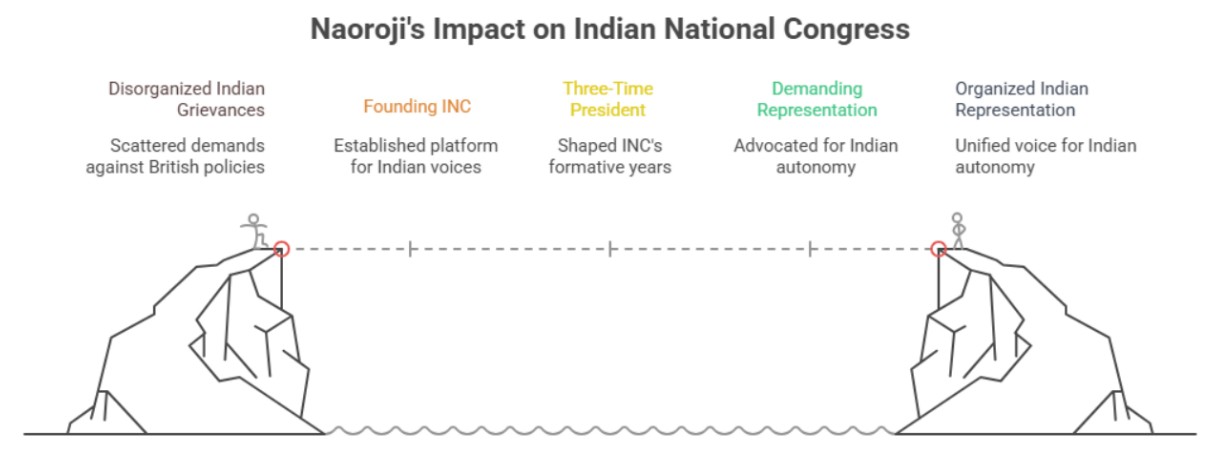
Dadabhai Naoroji played a pivotal role in establishing the Indian National Congress (INC) in 1885. He believed that a platform was necessary for Indians to voice their demands and grievances against British policies.
He served as the President of INC three times (1886, 1893, and 1906), shaping the organization in its formative years. Under his leadership, the Congress demanded greater Indian representation in the administration and more autonomy in local affairs.
In 1892, Dadabhai Naoroji became the first Indian to be elected to the British House of Commons, representing the Liberal Party from Central Finsbury. This was a historic moment that gave Indians a voice at the heart of the British Empire.
From the British Parliament, Dadabhai Naoroji raised issues related to Indian poverty, taxation, and representation. He consistently urged the British to introduce administrative reforms and ensure justice for Indians.
Before the INC, Dadabhai Naoroji founded the East India Association in London in 1866. The aim was to inform British citizens and lawmakers about Indian issues and advocate for Indian welfare.
The East India Association laid the foundation for future political organizations by creating awareness among the British public and gathering support for Indian causes.
Dadabhai Naoroji believed that true development could not happen without the upliftment of women. He actively supported female education, which was largely neglected during the colonial era.
He advocated for social reforms such as widow remarriage, abolition of child marriage, and improved rights for Indian women. His efforts marked him as a social reformer who looked beyond political independence.
Dadabhai Naoroji was a powerful writer who used journalism as a tool for social and political change. He edited several journals like the Rast Goftar and contributed to periodicals that highlighted the plight of Indians under British rule.
Apart from "Poverty and Un-British Rule in India", he wrote "The Causes of Indian Famines", emphasizing how British policies led to large-scale famines and human suffering.
Dadabhai Naoroji was a strong proponent of the Swadeshi Movement, which encouraged the use of Indian-made goods and the boycott of British products. He believed self-reliance was the key to India’s economic independence.
His belief in industrial development, indigenous enterprise, and rural empowerment inspired future leaders like Mahatma Gandhi and Jawaharlal Nehru.
Dadabhai Naoroji passed away in 1917, but his legacy continues to inspire. His Economic Drain Theory, push for Indian representation, and support for reforms laid the ideological foundation for India’s freedom struggle. His blend of intellectual depth, moral courage, and political strategy makes him a timeless hero of Indian history.
Even in today’s modern India, the thoughts and ideologies of Dadabhai Naoroji resonate deeply. His understanding of economics, belief in justice, and calls for self-governance continue to inspire political thinkers, economists, and social reformers.
From Parliament to the classroom, from social reforms to national policy debates, Dadabhai Naoroji stands tall as a pioneer who helped shape the idea of India as an independent nation.
Dadabhai Naoroji was not just a political leader; he was a movement in himself. He represented the voice of India at a time when the country was silent under colonial rule. His work in economics, politics, education, and social reform gave India the courage to demand freedom.


Refine your answer writing skills and elevate your UPSC preparation with personalized support and expert feedback.
Fill out the form to get started with the program or any other enquiries !

Are you dreaming of becoming an IAS officer? Then, IAShub can be your best guide. It is one of the Best IAS Coaching in Delhi. Many students who want to clear the UPSC exam join IAShub for learning. The institute gives both online and offline classes. Their teachers are experienced and helpful. They easily explain every topic. Students also get notes, tests, and tips to do well in the exam.
IAShub is in Delhi and is trusted by many UPSC students. It offers coaching for every part of the UPSC exam – Prelims, Mains, and Interview. The classes are simple and easy to understand. The teachers are experts and guide students in the right way. IAShub is also known for its helpful notes, test series, and answer-writing practice. IAShub is the best coaching in Delhi and also gives UPSC Online Classes. This helps students from any place in India to learn. The online classes are live and also recorded. So, students can watch them anytime. These classes cover the full UPSC syllabus.
Here are some important services provided by IAShub:
The UPSC Civil Services Exam has three parts:
This exam is tough, but with the right guidance, it becomes easy to manage. Students must study smart and stay regular.
IAShub supports students from the beginning to the end. It gives the right books, tests, and notes. The classes are easy to follow, and the teachers are always ready to help. Students get personal doubt sessions too. The test series and answer checking help students learn where they need to do better. Also, free study materials save time and money.
IAShub also guides students during the final stage – the interview. Experts take mock interviews and give useful tips. This full support makes IAShub one of the best IAS coaching in Delhi.
Join 39,000+ UPSC Aspirants! 🚀
Get Free UPSC/State PSC Study Materials, Daily Current Affairs Question & Exam Updates.
Join Telegram Channel
