


Know about ideology of Communism—its meaning, key types, benefits, and drawbacks. Understand how communism shapes politics, economies, and societies.
 theIASHub | 20 Jun, 2025 | 6875

Communism is a political and economic ideology that advocates for a classless, stateless society where all property and resources are collectively owned. Under communism, the goal is to abolish social classes, private property, and money, replacing them with a cooperative system where everyone contributes according to their ability and receives according to their need.
Rooted in the ideas of Karl Marx, especially from The Communist Manifesto (1848), communism opposes capitalist systems where wealth and power are concentrated in the hands of a few. Instead, it envisions a society where equality, justice, and fairness prevail.
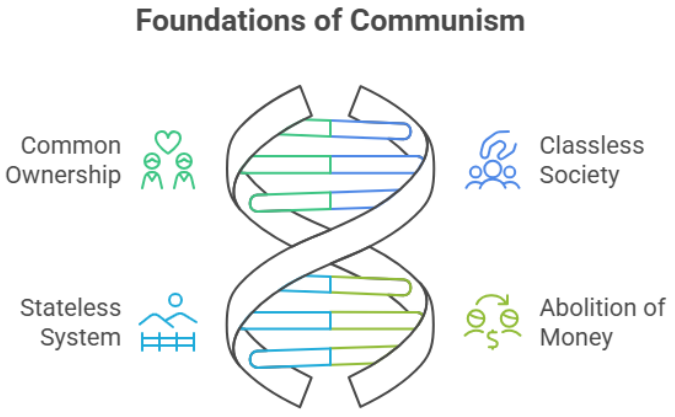
Communism promotes collective ownership of the means of production—land, factories, and resources—by the people or the state. No individual owns property for private gain.
A central aim of communism is to eliminate social classes, thereby ending exploitation between the bourgeoisie (owners) and proletariat (workers). This leads to a more equitable society.
In its ultimate form, communism envisions a stateless society where governance is unnecessary because equality and cooperation replace coercion and authority.
Communism seeks to do away with money and capitalist markets, replacing them with a system where goods and services are produced based on need and distributed accordingly.
Over time, communism evolved into different interpretations and schools of thought. Below are the major types of communism with their unique features:
The foundational theory of communism, Marxism critiques capitalism and proposes a revolutionary path to socialism and then communism. It emphasizes class struggle and the eventual overthrow of capitalist structures.
Developed by Vladimir Lenin and implemented by Joseph Stalin, Marxism-Leninism combines Marxist theory with Lenin’s strategies for revolution and governance. It supports a vanguard party, central planning, and state control as transitional measures toward communism.
An authoritarian model associated with Joseph Stalin, Stalinism includes centralized power, forced collectivization, secret police, and the suppression of dissent. It is often criticized for creating a totalitarian regime under the guise of communism.
Led by Leon Trotsky, this variant emphasizes international revolution and the need for global proletarian uprising. Trotsky criticized Stalinist communism for betraying revolutionary principles.
Based on Rosa Luxemburg’s ideas, this form of communism advocates for mass participation, democracy, and opposition to authoritarianism. It differs from Leninist approaches by promoting bottom-up reforms.
Derived from Mao Zedong’s teachings in China, Maoism adapts communism to agrarian societies and introduces concepts like the mass line, people’s war, and new democracy. It emphasizes revolutionary action through the rural peasantry.
Though often criticized, communism has had several positive impacts in theory and, in some cases, in practice:
Communism promotes equality by eliminating class divisions and redistributing wealth. It ensures that all individuals have equal access to resources, healthcare, education, and jobs.
Under communism, the means of production are owned by the community or state. This reduces the influence of powerful capitalists and prevents exploitation by private owners.
Communism advocates for a system where workers have control over their labor, eliminating the wage slavery often seen in capitalist systems. Labor becomes a collective, dignified endeavor.
With wealth and production managed collectively, communist societies aim to provide universal access to food, shelter, education, and healthcare—essentials that are sometimes inaccessible in capitalist countries.
Despite its theoretical strengths, communism has faced criticism for its implementation and practical outcomes:
Many communist regimes have limited freedom of speech, press, religion, and political opposition. The desire for a unified ideology often leads to censorship and repression.
Without market competition and profit incentives, communist economies often suffer from low productivity, misallocation of resources, and bureaucratic delays. Innovation tends to stagnate under rigid central planning.
In practice, communist governments have been associated with one-party rule, lack of democratic elections, and harsh crackdowns on dissent. Political pluralism is typically suppressed.
Several communist regimes—notably under Stalin, Mao, and Pol Pot—have been responsible for mass purges, forced labor camps, and widespread human rights abuses.
By eliminating personal profit and private ownership, communism often fails to motivate individuals to innovate or excel, which can hinder technological progress and economic growth.
|
Feature |
Communism |
Capitalism |
|
Ownership of Property |
Collective / State |
Private |
|
Class System |
Classless society |
Stratified by wealth |
|
Distribution of Resources |
Based on need |
Based on purchasing power |
|
Incentives |
Collective good |
Profit-driven |
|
Role of Government |
Central planning, control |
Limited intervention (ideally) |
|
Freedom of Choice |
Limited |
Broad individual freedoms |
Yes, communism continues to influence political thought and policies around the world. While few countries practice pure communism, socialist-communist hybrids exist in nations like China, Vietnam, and Cuba. Additionally, communist parties and leftist movements remain active in several democracies.
Modern challenges—like economic inequality, corporate monopolies, and climate change—have revived interest in communist and socialist ideas as potential alternatives to unregulated capitalism.
Communism remains one of the most powerful and controversial ideologies of the modern era. Its vision of a classless, equitable society appeals to many, especially in the face of global inequality. However, its real-world implementations have often fallen short of these ideals, leading to economic inefficiency, political repression, and human rights violations.
Still, understanding communism—its types, benefits, and failures—is essential for anyone studying politics, economics, or social change in the 21st century.


Refine your answer writing skills and elevate your UPSC preparation with personalized support and expert feedback.
Fill out the form to get started with the program or any other enquiries !

Are you dreaming of becoming an IAS officer? Then, IAShub can be your best guide. It is one of the Best IAS Coaching in Delhi. Many students who want to clear the UPSC exam join IAShub for learning. The institute gives both online and offline classes. Their teachers are experienced and helpful. They easily explain every topic. Students also get notes, tests, and tips to do well in the exam.
IAShub is in Delhi and is trusted by many UPSC students. It offers coaching for every part of the UPSC exam – Prelims, Mains, and Interview. The classes are simple and easy to understand. The teachers are experts and guide students in the right way. IAShub is also known for its helpful notes, test series, and answer-writing practice. IAShub is the best coaching in Delhi and also gives UPSC Online Classes. This helps students from any place in India to learn. The online classes are live and also recorded. So, students can watch them anytime. These classes cover the full UPSC syllabus.
Here are some important services provided by IAShub:
The UPSC Civil Services Exam has three parts:
This exam is tough, but with the right guidance, it becomes easy to manage. Students must study smart and stay regular.
IAShub supports students from the beginning to the end. It gives the right books, tests, and notes. The classes are easy to follow, and the teachers are always ready to help. Students get personal doubt sessions too. The test series and answer checking help students learn where they need to do better. Also, free study materials save time and money.
IAShub also guides students during the final stage – the interview. Experts take mock interviews and give useful tips. This full support makes IAShub one of the best IAS coaching in Delhi.
Join 39,000+ UPSC Aspirants! 🚀
Get Free UPSC/State PSC Study Materials, Daily Current Affairs Question & Exam Updates.
Join Telegram Channel
