


Explore the American War of Independence in detail—timeline, causes, and global impact of the first successful modern revolution against British rule.
 theIASHub | 13 Jun, 2025 | 5173

The American War Of Independence (1765–1783) was a landmark event in world history. It marked the thirteen British colonies' successful fight for freedom and led to the birth of the United States of America. This revolution was driven by deep-rooted grievances, Enlightenment ideals, and a desire for self-rule. It not only transformed America but also inspired movements across the globe.
The famous line from the Declaration of Independence, “all men are created equal… endowed with certain unalienable Rights,” captures the core ideology that defined this historic movement.
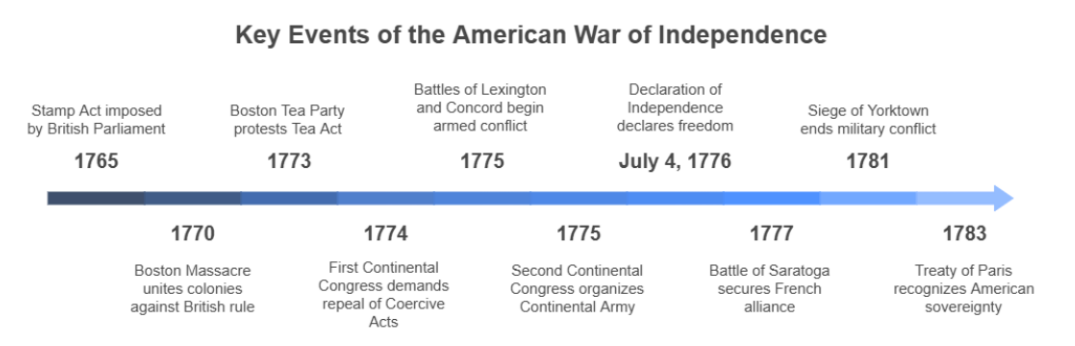
The British Parliament imposed the Stamp Act, a direct tax on printed materials in the colonies. It led to protests and the rise of the ‘Sons of Liberty’, setting the stage for the revolution.
British troops killed five colonists in a street clash. This event intensified anti-British emotions and united the colonies against imperial rule.
American patriots, protesting the Tea Act, dumped 342 chests of British tea into Boston Harbor. Britain retaliated with the Coercive Acts, heightening tensions.
Representatives from 12 colonies convened in Philadelphia, agreeing to boycott British goods and demand repeal of the Coercive Acts.
These were the first armed clashes of the American War Of Independence. British forces tried to seize colonial arms, but the colonial militia resisted fiercely.
This Congress organized the Continental Army under George Washington and prepared for full-scale war.
The Continental Congress formally declared independence from Britain on July 4, 1776. It justified the break and presented a vision of a free, democratic society.
This major victory for the Americans convinced France to join the war against Britain, altering the course of the revolution.
A joint American-French force surrounded British General Cornwallis, forcing his surrender and marking the war's end in military terms.
The treaty formally ended the American War Of Independence. Britain recognized American sovereignty, and peace was restored.
British trade policies and monopolies limited colonial economic freedom, fostering resentment and desire for independence.
After the Seven Years' War, Britain banned westward expansion, angering colonists who had fought for land rights.
Thinkers like Locke, Rousseau, and Montesquieu inspired colonists with ideas about liberty, natural rights, and representative government.
Colonists opposed British-imposed taxes like the Stamp Act and Tea Act, arguing they had no voice in Parliament—a violation of their rights.
Britain sought to recover war expenses by taxing the colonies, leading to organized resistance and rebellion.
Known as the Intolerable Acts, these punitive measures targeted Massachusetts and fueled demands for self-governance.
Positive:
The Treaty of Paris 1783 ended British rule and established the United States as a sovereign nation. It created the world’s first democratic republic based on a written constitution, setting a model for governance.
Negative:
The Articles of Confederation, initially used for governance, were too weak. It led to instability until the U.S. Constitution was adopted in 1787. Political rights were limited to white male property owners.
Positive:
The revolution promoted ideas of liberty, equality, and human rights. It planted seeds for later reforms, including abolitionism and civil rights movements.
Negative:
Slavery continued, and racism remained entrenched. Women and Native Americans gained little from the revolution, and class distinctions persisted.
Positive:
The new nation pursued industrialization, trade expansion, and land development. The American War Of Independence laid the foundation for U.S. economic strength.
Negative:
War debts burdened the new government. Native tribes suffered land loss and displacement as settlers expanded westward.
The success of the American War Of Independence inspired revolutionary movements worldwide, including the French Revolution, and independence struggles in Latin America. It showed that empires could be challenged and dismantled.
The American War Of Independence was more than a fight for political separation; it was a movement rooted in the ideals of liberty, justice, and self-governance. Though the new nation faced many challenges—social inequality, economic hardship, and political instability—the war laid the groundwork for the world’s most enduring democracy.
Its global influence cannot be overstated. It empowered people across the globe to question authority and fight for their rights. Even today, the principles born from the American War Of Independence continue to shape modern political thought and democratic institutions.


Refine your answer writing skills and elevate your UPSC preparation with personalized support and expert feedback.
Fill out the form to get started with the program or any other enquiries !

Are you dreaming of becoming an IAS officer? Then, IAShub can be your best guide. It is one of the Best IAS Coaching in Delhi. Many students who want to clear the UPSC exam join IAShub for learning. The institute gives both online and offline classes. Their teachers are experienced and helpful. They easily explain every topic. Students also get notes, tests, and tips to do well in the exam.
IAShub is in Delhi and is trusted by many UPSC students. It offers coaching for every part of the UPSC exam – Prelims, Mains, and Interview. The classes are simple and easy to understand. The teachers are experts and guide students in the right way. IAShub is also known for its helpful notes, test series, and answer-writing practice. IAShub is the best coaching in Delhi and also gives UPSC Online Classes. This helps students from any place in India to learn. The online classes are live and also recorded. So, students can watch them anytime. These classes cover the full UPSC syllabus.
Here are some important services provided by IAShub:
The UPSC Civil Services Exam has three parts:
This exam is tough, but with the right guidance, it becomes easy to manage. Students must study smart and stay regular.
IAShub supports students from the beginning to the end. It gives the right books, tests, and notes. The classes are easy to follow, and the teachers are always ready to help. Students get personal doubt sessions too. The test series and answer checking help students learn where they need to do better. Also, free study materials save time and money.
IAShub also guides students during the final stage – the interview. Experts take mock interviews and give useful tips. This full support makes IAShub one of the best IAS coaching in Delhi.
Join 39,000+ UPSC Aspirants! 🚀
Get Free UPSC/State PSC Study Materials, Daily Current Affairs Question & Exam Updates.
Join Telegram Channel
