


Explore how the Indian government is countering Naxalism in India with security operations, development programs, and community engagement for lasting peace.
 theIASHub | 19 Aug, 2025

The challenge of Naxalism in India has persisted for decades, deeply affecting several states across central and eastern India. Rooted in socio-economic disparities, land rights issues, and governance failures, Naxalism—also known as Left Wing Extremism (LWE)—has evolved into an armed struggle that threatens national security and the well-being of tribal and rural populations.
To counter this, the Indian government has adopted a multi-pronged strategy that includes security operations, development initiatives, community engagement, and policy reforms. This article explores the various measures undertaken and the way forward in addressing the complex issue of Naxalism in India.
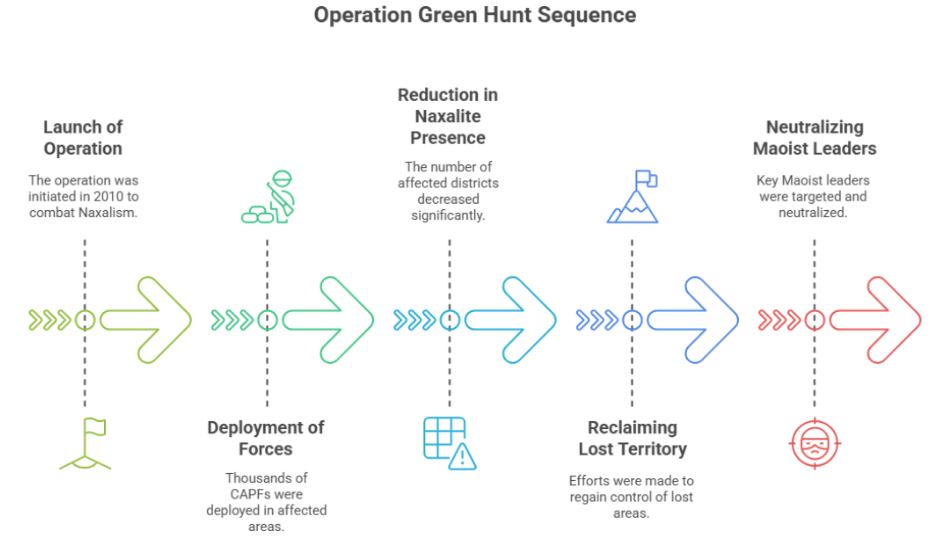
Launched in 2010, Operation Green Hunt was one of the first large-scale security offensives against Naxalism in India.
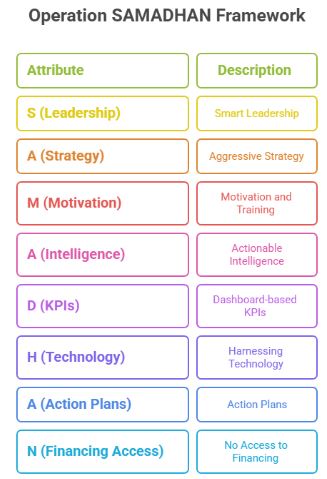
A more strategic framework, Operation SAMADHAN stands for:
This operation reflects a holistic strategy against Naxalism in India, integrating security and intelligence in a coordinated way.
Launched in 2017, Operation Prahar focuses on targeted strikes against Maoist camps and hideouts, especially in remote jungles of Chhattisgarh, Odisha, and Maharashtra.
The government has set up Joint Task Forces across inter-state borders where Naxalism thrives due to geographical advantages.
Naxal-affected areas often suffer from extreme underdevelopment. The Aspirational Districts Programme addresses this by focusing on:
This initiative directly tackles the root causes of Naxalism in India—inequality and marginalization.
The central government launched the Scheme for Special Infrastructure in LWE-affected states to improve:
By improving accessibility and state presence, the scheme reduces the influence of Maoist propaganda.
To build trust, the government supports Civic Action Programs like:
These initiatives help in winning the hearts and minds of people affected by Naxalism in India.
The government is increasingly using drones and mini-UAVs to track Maoist movement.
Upgraded technical intelligence systems have strengthened the capability to:
Technology has transformed the way Naxalism in India is tackled on the ground.
Recognizing tribal rights over forest land and resources has been a game-changer.
Ensuring fair compensation, rehabilitation, and resettlement of people displaced by development projects is crucial.
Maoists are encouraged to surrender peacefully through programs offering:
This policy has helped hundreds of former Naxalites rejoin mainstream society.
Efforts are underway to:
To match the tactical capabilities of Maoists, state police forces are being trained by the Ministry of Defence.
The fight against Naxalism in India cannot be won through force alone.
A stronger center-state coordination mechanism is needed to ensure consistency in planning and execution.
Investments in sustainable agriculture, clean water, renewable energy, and local entrepreneurship will reduce Naxalism’s appeal.
Better roads, mobile networks, and electricity in remote areas are essential to restore state control and public services.
The Indian government has made significant progress in reducing Naxalite violence over the past decade. From 223 affected districts in 2010 to 90 by 2019, this success is not just a result of guns and drones, but of a comprehensive, people-centric approach.
By continuing to invest in security, justice, development, and dialogue, India can bring lasting peace to the regions long plagued by Naxalism.


Refine your answer writing skills and elevate your UPSC preparation with personalized support and expert feedback.
Fill out the form to get started with the program or any other enquiries !

Are you dreaming of becoming an IAS officer? Then, IAShub can be your best guide. It is one of the Best IAS Coaching in Delhi. Many students who want to clear the UPSC exam join IAShub for learning. The institute gives both online and offline classes. Their teachers are experienced and helpful. They easily explain every topic. Students also get notes, tests, and tips to do well in the exam.
IAShub is in Delhi and is trusted by many UPSC students. It offers coaching for every part of the UPSC exam – Prelims, Mains, and Interview. The classes are simple and easy to understand. The teachers are experts and guide students in the right way. IAShub is also known for its helpful notes, test series, and answer-writing practice. IAShub is the best coaching in Delhi and also gives UPSC Online Classes. This helps students from any place in India to learn. The online classes are live and also recorded. So, students can watch them anytime. These classes cover the full UPSC syllabus.
Here are some important services provided by IAShub:
The UPSC Civil Services Exam has three parts:
This exam is tough, but with the right guidance, it becomes easy to manage. Students must study smart and stay regular.
IAShub supports students from the beginning to the end. It gives the right books, tests, and notes. The classes are easy to follow, and the teachers are always ready to help. Students get personal doubt sessions too. The test series and answer checking help students learn where they need to do better. Also, free study materials save time and money.
IAShub also guides students during the final stage – the interview. Experts take mock interviews and give useful tips. This full support makes IAShub one of the best IAS coaching in Delhi.
Join 39,000+ UPSC Aspirants! 🚀
Get Free UPSC/State PSC Study Materials, Daily Current Affairs Question & Exam Updates.
Join Telegram Channel
