The Deep Impact of Naxalism on Indian Society

Explore the wide-ranging impact of Naxalism on India’s society, economy, politics, and security, including displacement, violence, and governance challenges.

THEIASHUB
Get an Instant Call Back from Our Expert Mentors Now!
+91

The impact of Naxalism in India goes far beyond violent clashes. It affects the core of society—disrupting development, destroying infrastructure, creating psychological trauma, and weakening institutions. What began as a rebellion against inequality has now turned into a multi-dimensional crisis with social, economic, political, security, and psychological consequences.

To understand how to effectively respond, it’s crucial to evaluate the impact of Naxalism in each of these spheres. Only then can policies be designed not just to defeat the insurgency militarily but also to heal the affected regions holistically.
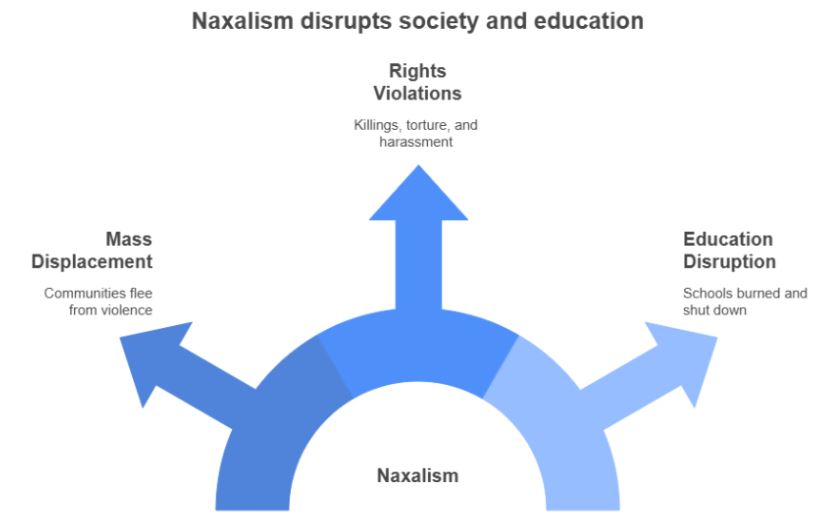
Social Impact of Naxalism

Mass Displacement of Tribal and Rural Populations

One of the most severe social impacts of Naxalism is the displacement of communities, particularly in forest and tribal belts of central and eastern India.

  • Villages located in Naxalite conflict zones often become battlefields.
  • Thousands are forced to flee their homes due to fear of violence from both Maoists and security forces.
  • This displacement breaks community ties and leaves families without shelter or means of livelihood.

Human Rights Violations

Both Maoist insurgents and security forces have been accused of human rights violations in the conflict zones.

  • Maoists often abduct and kill local leaders or those who oppose them.
  • Security forces, during anti-Naxal operations, have also been accused of extrajudicial killings, torture, and harassment.
  • Women and children are especially vulnerable to abuse, creating an environment of fear and lawlessness.

Disruption of Education

The impact of Naxalism on education has been disastrous in conflict-affected areas.

  • Schools are burned, shut down, or occupied by Maoists or paramilitary forces.
  • Teachers often refuse to work in high-risk areas, leading to a lack of access to education for local children.
  • As a result, generations of children grow up illiterate, fueling the cycle of poverty and rebellion.

Economic Impact of Naxalism

Developmental Setbacks

The impact of Naxalism on regional development has been deeply negative.

  • Infrastructure projects like roads, railways, bridges, and power stations are often attacked or halted by Maoists.
  • This prevents much-needed connectivity and growth in backward regions.
  • Health centres and rural development offices are also frequent targets, halting progress.

Loss of Investment and Economic Confidence

The impact of Naxalism on economic growth is clearly visible in the Red Corridor, which spans over 100 districts.

  • Due to instability, both Indian and foreign investors stay away from the region.
  • Businesses fear damage to property, threats to staff, and extortion by armed groups.
  • This keeps these areas stuck in a low-growth trap, increasing inequality and poverty.

Illegal Exploitation of Natural Resources

Naxalites control and exploit mineral-rich areas, especially in Jharkhand, Chhattisgarh, and Odisha.

  • Engaged in illegal mining of coal, iron ore, and bauxite, the rebels extract resources without environmental checks.
  • Forest timber is also harvested illegally and sold through black markets.
  • This denies the government legitimate revenue and destroys the ecological balance.

Political Impact of Naxalism

Challenges in Governance

The impact of Naxalism on governance is evident through weakened state presence in affected areas.

  • Local administrators, police officers, and elected representatives are frequent targets.
  • This discourages governance efforts, leaving a vacuum filled by Maoist influence.
  • Basic services such as ration delivery, health schemes, and recordkeeping become inaccessible.

Erosion of Public Trust

Continuous violence and misgovernance undermine trust in government institutions.

  • Corruption and failed promises make people lose faith in democracy and the justice system.
  • Maoist "People's Courts" take over dispute resolution, even gaining some support for swift local decisions.
  • This creates a parallel political structure, which challenges state legitimacy.

Security Impact of Naxalism

Escalation of Violence

The impact of Naxalism on national security is a major concern.

  • Armed Maoists engage in frequent ambushes, landmine blasts, and attacks on security forces.
  • Civilians are often caught in the crossfire, leading to casualties and long-term fear.
  • High-profile attacks like those in Dantewada and Sukma illustrate the scale and intensity of Naxalite aggression.

Burden on Security Forces

India has deployed thousands of personnel from CRPF, BSF, and state police to fight Naxalism.

  • These prolonged operations strain resources, manpower, and morale.
  • Forces also face challenges in terrain, intelligence, and public cooperation.
  • The lack of a clear exit strategy means the conflict drags on, draining the system.

Psychological Impact of Naxalism

Widespread Trauma

Living under the shadow of constant violence creates deep psychological scars.

  • Children grow up with mental stress, anxiety, and disrupted childhoods.
  • Adults suffer from PTSD, depression, and hopelessness due to loss of family members and livelihood.
  • The impact of Naxalism on emotional well-being is rarely discussed, yet it remains one of the most damaging effects.

Breakdown of Daily Life and Normalcy

In Naxal-hit areas, normal life is a daily struggle.

  • Night travel becomes unsafe, markets shut early, and social gatherings become risky.
  • Villagers are forced to live in a state of permanent fear and unpredictability.
  • This psychological impact reduces community bonding and stability, isolating people further.

A Holistic View of the Impact of Naxalism

The impact of Naxalism is multi-faceted and continues to cripple large parts of rural India.

Impact Category

Key Consequences

Social

Displacement, human rights abuse, loss of education

Economic

Halted development, loss of investment, illegal resource extraction

Political

Governance collapse, loss of faith in democracy

Security

Increased insurgent attacks, strained security forces

Psychological

Trauma, anxiety, and long-term mental health damage


Conclusion: Addressing the Impact of Naxalism

To counter the impact of Naxalism, India needs a comprehensive approach:

  • Military operations must be combined with socio-economic development.
  • Tribal rights and land reforms should be respected and enforced.
  • Quality education, healthcare, and employment must reach every corner.
  • Psychological counselling and rehabilitation of surrendered cadres are crucial.
  • A transparent, just, and responsive governance system must replace the current cycle of conflict and neglect.

By understanding and addressing the full spectrum of the impact of Naxalism, India can pave the way for a more peaceful and inclusive future in its most vulnerable regions.



UPSC QEP 2026 Batch 5 - English
Buy now View Details
Submit Your Details to Learn More
I agree to give my consent to receive updates through SMS/Email & WhatsApp*.

NEEV GS + CSAT Foundation 2026/27
Buy now View Details


Join theIAShub’s Mains Answer Writing Program

Refine your answer writing skills and elevate your UPSC preparation with personalized support and expert feedback.

Fill out the form to get started with the program or any other enquiries !

I agree to give my consent to receive updates through SMS/Email & WhatsApp*.

Best IAS Coaching In Delhi, UPSC Online & Offline Classes by IAShub

Are you dreaming of becoming an IAS officer? Then, IAShub can be your best guide. It is one of the Best IAS Coaching in Delhi. Many students who want to clear the UPSC exam join IAShub for learning. The institute gives both online and offline classes. Their teachers are experienced and helpful. They easily explain every topic. Students also get notes, tests, and tips to do well in the exam.

UPSC Online Classes by IAShub

IAShub is in Delhi and is trusted by many UPSC students. It offers coaching for every part of the UPSC exam – Prelims, Mains, and Interview. The classes are simple and easy to understand. The teachers are experts and guide students in the right way. IAShub is also known for its helpful notes, test series, and answer-writing practice. IAShub is the best coaching in Delhi and also gives UPSC Online Classes. This helps students from any place in India to learn. The online classes are live and also recorded. So, students can watch them anytime. These classes cover the full UPSC syllabus.

Key Offerings Provided by IAShub

Here are some important services provided by IAShub:

  • UPSC Prelims: IAShub teaches for Prelims with a focus on basics. It also gives daily current affairs and monthly magazines.
  • Classroom Courses: IAShub has classroom learning for students in Delhi. The environment is good and peaceful for study.
  • Live Classes: Students who live far can join live UPSC online classes. These classes are just like real classes.
  • QEP for Mains: The Quality Enrichment Program (QEP) is special for Mains preparation. It helps students write better and faster.
  • Answer Writing: Regular answer writing practice is given. Teachers also check answers and give tips to improve.
  • Free Resource: IAShub gives free notes by toppers and helpful Main Booster material.
  • Test Series: Test series are available for every subject. These help students know their weak points and improve.
  • Interview Guidance Session: IAShub also gives interview practice sessions with experts. These help students feel confident.

UPSC Exam Overview

The UPSC Civil Services Exam has three parts:

  • Prelims: It has two papers: General Studies and CSAT.
  • Mains: It has nine papers, including essays and optional subjects.
  • Interview: It tests the personality and confidence of the student.

This exam is tough, but with the right guidance, it becomes easy to manage. Students must study smart and stay regular.

How IAShub Helps in the UPSC Journey

IAShub supports students from the beginning to the end. It gives the right books, tests, and notes. The classes are easy to follow, and the teachers are always ready to help. Students get personal doubt sessions too. The test series and answer checking help students learn where they need to do better. Also, free study materials save time and money.
IAShub also guides students during the final stage – the interview. Experts take mock interviews and give useful tips. This full support makes IAShub one of the best IAS coaching in Delhi.

Best IAS Coaching In Delhi FAQs

Yes, IAShub offers live and recorded online classes. Students can attend from any part of India.

Classes are available in both English and Hindi, so students can choose the language they are comfortable with.

The classroom centre is located in Delhi. Students can visit and join offline batches there.

IAShub gives interview guidance sessions to help students prepare for the final round of UPSC.