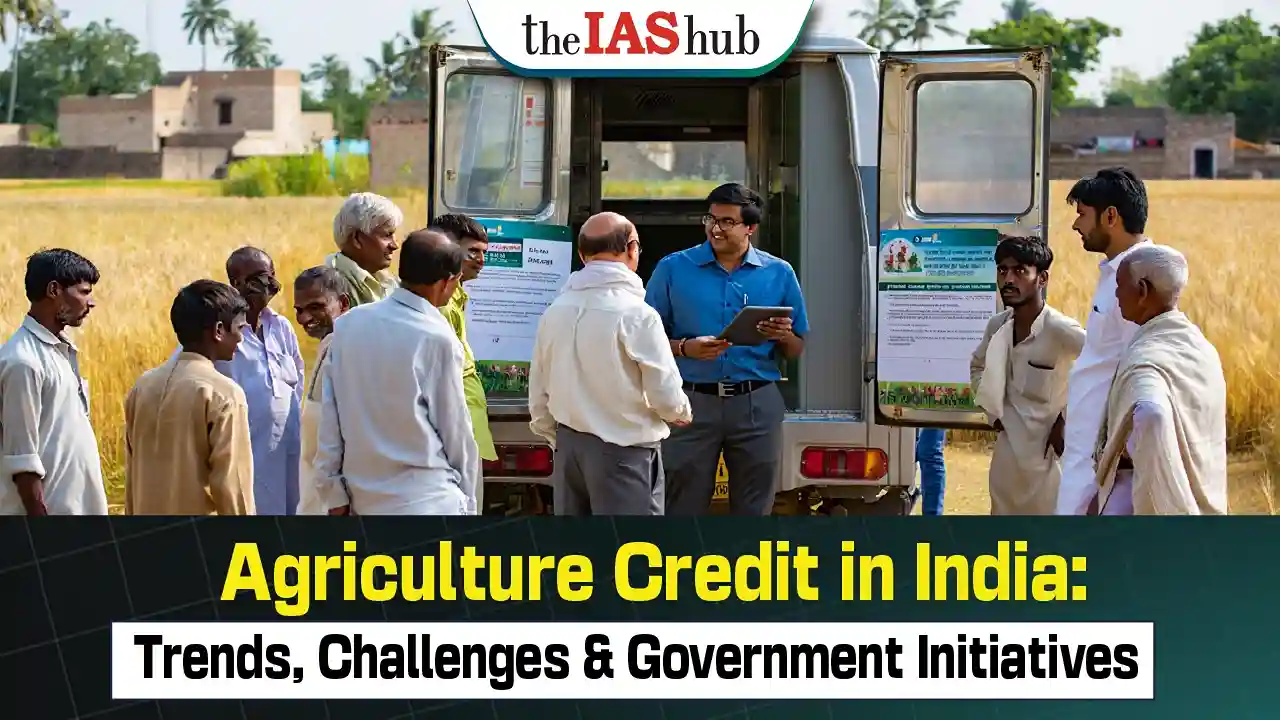
Agriculture Credit in India: Trends, Challenges & Government Initiatives

Explore the agriculture credit scenario in India, covering institutional credit trends, challenges like regional disparities and low small farmer coverage, key government schemes, and the way forward for inclusive agricultural financing.

THEIASHUB
Get an Instant Call Back from Our Expert Mentors Now!
+91

Agricultuiral Credit scenario: Agricultural credit is critical input to agriculture and helps in creating environment for the adoption of modern production technology and encouraging private investments on the farms.


Trends and Patterns in Agriculture Credit in India

  • During 2019-20, the institutional credit flow to the agriculture sector in India was to the tune of Rs.13.93 lakh crore against the target of Rs.13.50 lakh crore.
  • NABARD All India Rural Financial Inclusion Survey conducted for 2015-16 also reported that institutional sources accounted for only 72 percent of the loans taken by an average farm household (HH), and the remaining 28 percent came from non-institutional sources .

Problems with Agriculture Credit in India

  • Regional Disparities in Credit Dispensation: The share of Southern Region in the total agriculture credit flow has increased continuously from the year 2016-17 whereas the share of other regions except Eastern and Northeast Regions has decreased from 2013-14 to 2019-20.
  • Low coverage of Small and Marginal Farmers: Their share in loan disbursed by Commercial Banks is at a lower level of around 47.3 per cent during 2019-2020.
  • Dependency on non-institutional credit- due to the complex and rigid process of the banking sector, lack of collateral.
  • Diversion of loans to non-Agriculturalal purposes due to extra expenditure to other day to day expenses.
  • Red Tapism: Credit institutions are still adopting cumbersome rules and formalities for advancing loan to farmers which ultimately force the farmers to depend more on costly non-institutional sources of credit.

Key Government Initiatives for Agriculture Credit in India 

  • Kisan Credit Card Scheme: To provide adequate and timely credit support from the banking systems to the farmers for their cultivation and other needs like- Post harvest expense; Produce marketing loan.
  • Modified Interest Subvention Scheme (MISS): Under this scheme, farmers are given KCC loan at interest rate of 7% per annum for loans unto Rs 3 Lakhs.
  • Scheme for financing of Joint Liability Groups of Tenant Farmers: It was started by NABARD to give 100 percent refinance support to banks. 
  • Priority Sector Lending: 18% of loans of commercial banks to agricultural sector.

Way forward 

  • Widen reach of agriculture credit- by digitization and updating land records, strong and federal institution like GST for undermining process and implementation of reforms.
  • Address regional disparity - by giving more focus and allocation to lagged states.
  • Use of FPO and other initiatives to increase risk bearing ability of farmers.
  • Credit for small and marginal farmers:  It recommended that the lending target for small and marginal farmers should be revised from the existing 8% to 10% with a roadmap of two years.
  • Policies regarding loan waiving -    the central and state governments should undertake a holistic review of agricultural policies and input subsidies in order to improve the overall viability and sustainability of agriculture.

Agriculture Credit in India: Trends, Challenges & Government Initiatives FAQs

Agriculture credit refers to loans and financial support provided to farmers to help with crop production, buying inputs, and adopting modern farming techniques.

Institutional sources like banks, NABARD, and cooperative societies provide most agriculture credit, while non-institutional sources also play a role, especially for small farmers.

Farmers face issues such as regional disparities, low coverage for small and marginal farmers, dependency on costly non-institutional loans, and complicated banking procedures.

Key schemes include the Kisan Credit Card (KCC), Modified Interest Subvention Scheme (MISS), Joint Liability Groups financing, and Priority Sector Lending by banks.

Improvements include digitizing land records, addressing regional disparities, increasing credit access for small farmers, and revising policies on loan waivers and subsidies.


UPSC QEP 2026 Batch 5 - English
Buy now View Details
Submit Your Details to Learn More
I agree to give my consent to receive updates through SMS/Email & WhatsApp*.

NEEV GS + CSAT Foundation 2026/27
Buy now View Details


Join theIAShub’s Mains Answer Writing Program

Refine your answer writing skills and elevate your UPSC preparation with personalized support and expert feedback.

Fill out the form to get started with the program or any other enquiries !
I agree to give my consent to receive updates through SMS/Email & WhatsApp*.

Best IAS Coaching In Delhi, UPSC Online & Offline Classes by IAShub

Are you dreaming of becoming an IAS officer? Then, IAShub can be your best guide. It is one of the Best IAS Coaching in Delhi. Many students who want to clear the UPSC exam join IAShub for learning. The institute gives both online and offline classes. Their teachers are experienced and helpful. They easily explain every topic. Students also get notes, tests, and tips to do well in the exam.

UPSC Online Classes by IAShub

IAShub is in Delhi and is trusted by many UPSC students. It offers coaching for every part of the UPSC exam – Prelims, Mains, and Interview. The classes are simple and easy to understand. The teachers are experts and guide students in the right way. IAShub is also known for its helpful notes, test series, and answer-writing practice. IAShub is the best coaching in Delhi and also gives UPSC Online Classes. This helps students from any place in India to learn. The online classes are live and also recorded. So, students can watch them anytime. These classes cover the full UPSC syllabus.

Key Offerings Provided by IAShub

Here are some important services provided by IAShub:

  • UPSC Prelims: IAShub teaches for Prelims with a focus on basics. It also gives daily current affairs and monthly magazines.
  • Classroom Courses: IAShub has classroom learning for students in Delhi. The environment is good and peaceful for study.
  • Live Classes: Students who live far can join live UPSC online classes. These classes are just like real classes.
  • QEP for Mains: The Quality Enrichment Program (QEP) is special for Mains preparation. It helps students write better and faster.
  • Answer Writing: Regular answer writing practice is given. Teachers also check answers and give tips to improve.
  • Free Resource: IAShub gives free notes by toppers and helpful Main Booster material.
  • Test Series: Test series are available for every subject. These help students know their weak points and improve.
  • Interview Guidance Session: IAShub also gives interview practice sessions with experts. These help students feel confident.

UPSC Exam Overview

The UPSC Civil Services Exam has three parts:

  • Prelims: It has two papers: General Studies and CSAT.
  • Mains: It has nine papers, including essays and optional subjects.
  • Interview: It tests the personality and confidence of the student.

This exam is tough, but with the right guidance, it becomes easy to manage. Students must study smart and stay regular.

How IAShub Helps in the UPSC Journey

IAShub supports students from the beginning to the end. It gives the right books, tests, and notes. The classes are easy to follow, and the teachers are always ready to help. Students get personal doubt sessions too. The test series and answer checking help students learn where they need to do better. Also, free study materials save time and money.
IAShub also guides students during the final stage – the interview. Experts take mock interviews and give useful tips. This full support makes IAShub one of the best IAS coaching in Delhi.

Best IAS Coaching In Delhi FAQs

Yes, IAShub offers live and recorded online classes. Students can attend from any part of India.

Classes are available in both English and Hindi, so students can choose the language they are comfortable with.

The classroom centre is located in Delhi. Students can visit and join offline batches there.

IAShub gives interview guidance sessions to help students prepare for the final round of UPSC.