


Learn the role, advantages, and key challenges of pressure groups in Indian democracy. Understand how pressure groups influence policy without contesting elections.
 theIASHub | 15 May, 2025

A pressure group is an organized group or association that aims to influence public policies and decisions without contesting elections. Unlike political parties, a pressure group does not seek direct power but instead works to promote specific interests of its members or a section of society. These groups play a vital role in democratic societies by ensuring public participation, holding authorities accountable, and voicing diverse opinions.
Examples of pressure groups include trade unions, farmer unions like the Kisan Union, industry associations like FICCI, and advocacy bodies such as SEWA and NCW.
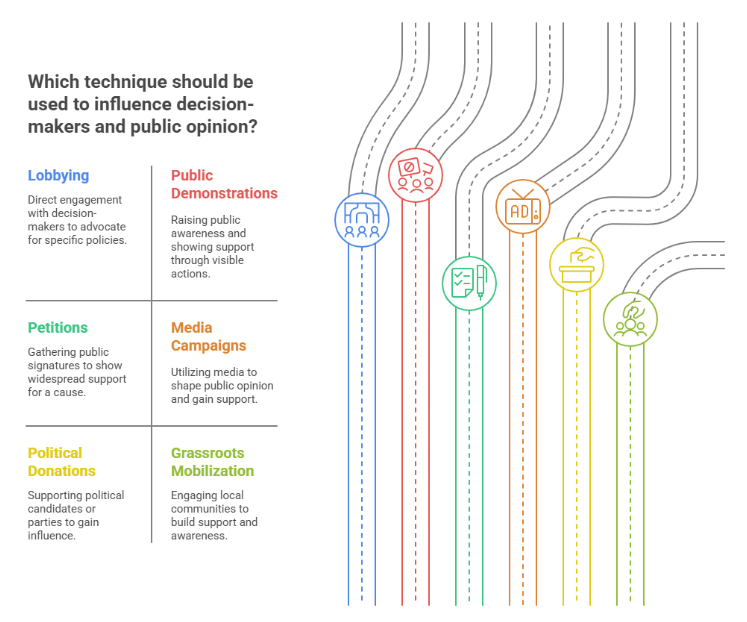
Pressure groups use several methods to influence decision-makers and public opinion:
A pressure group focuses on specific interests (e.g., farmers or workers), whereas political parties seek the support of all sections of society to win elections.
Political parties aim to gain power and form governments. On the other hand, a pressure group aims to influence policies and decisions without contesting elections.
Political parties use constitutional means, while pressure groups may also use extra-constitutional methods, such as strikes and public protests.
One cannot be part of more than one political party at a time. However, an individual can join multiple pressure groups depending on their interests.
Pressure groups act as the voice of the people. For instance, SEWA and NCW played a key role in the enactment of the Protection of Women from Domestic Violence Act, 2005.
These groups can push for laws aligned with their beliefs. For example, FICCI advocated for the removal of outdated laws to promote ease of doing business.
Pressure groups spread information and raise awareness about important social and political issues, encouraging political participation even among the uninformed.
By continuously monitoring and pressuring government actions, pressure groups ensure accountability and transparency.
Movements like India Against Corruption (IAC) connected public sentiment with policy discussions, acting as a bridge between citizens and the state.
Pressure groups foster debate, educate the masses, and promote democratic values through public engagement.
Many pressure groups operate without transparency or internal democracy, raising questions about their legitimacy.
Some pressure groups have more resources and influence than others. For example, industry lobbies often overshadow environmental groups in policy-making.
Certain pressure groups operate with hidden agendas, which may conflict with national interests. For instance, anti-Kudankulam protests affected India’s energy plans.
Caste-based or religious pressure groups may deepen divisions. Movements like “sons of soil” or cow vigilante groups have created social unrest.
Though unelected, pressure groups often wield significant influence. Sometimes, they become tools of political manipulation, especially in issues like reservations or religious demands.


Refine your answer writing skills and elevate your UPSC preparation with personalized support and expert feedback.
Fill out the form to get started with the program or any other enquiries !

Are you dreaming of becoming an IAS officer? Then, IAShub can be your best guide. It is one of the Best IAS Coaching in Delhi. Many students who want to clear the UPSC exam join IAShub for learning. The institute gives both online and offline classes. Their teachers are experienced and helpful. They easily explain every topic. Students also get notes, tests, and tips to do well in the exam.
IAShub is in Delhi and is trusted by many UPSC students. It offers coaching for every part of the UPSC exam – Prelims, Mains, and Interview. The classes are simple and easy to understand. The teachers are experts and guide students in the right way. IAShub is also known for its helpful notes, test series, and answer-writing practice. IAShub is the best coaching in Delhi and also gives UPSC Online Classes. This helps students from any place in India to learn. The online classes are live and also recorded. So, students can watch them anytime. These classes cover the full UPSC syllabus.
Here are some important services provided by IAShub:
The UPSC Civil Services Exam has three parts:
This exam is tough, but with the right guidance, it becomes easy to manage. Students must study smart and stay regular.
IAShub supports students from the beginning to the end. It gives the right books, tests, and notes. The classes are easy to follow, and the teachers are always ready to help. Students get personal doubt sessions too. The test series and answer checking help students learn where they need to do better. Also, free study materials save time and money.
IAShub also guides students during the final stage – the interview. Experts take mock interviews and give useful tips. This full support makes IAShub one of the best IAS coaching in Delhi.
 Detailed Solutions & Explanations
Improve Your Answer Writing & Strategy
Detailed Solutions & Explanations
Improve Your Answer Writing & Strategy

