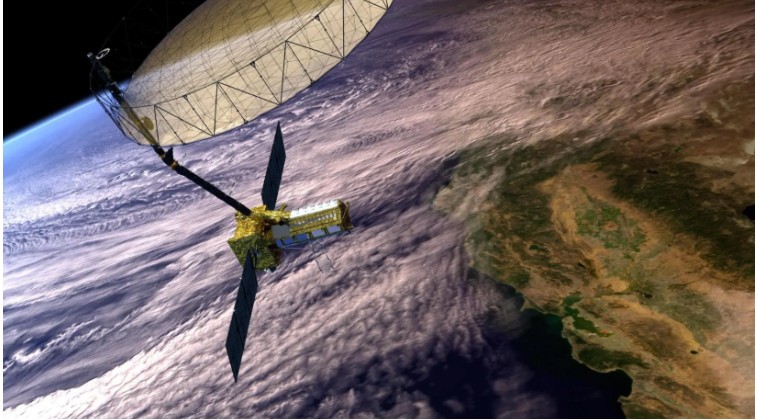
NISAR Satellite: India-USA Joint Earth Observation Mission Launched Successfully

Discover the NISAR Satellite, a joint collaboration between NASA and ISRO, launched from Sriharikota. Learn about its objectives, applications, working, and contribution to climate monitoring, disaster management, and Earth observation.

upsc-daily-current-affairs
THEIASHUB
Get an Instant Call Back from Our Expert Mentors Now!
+91

Context


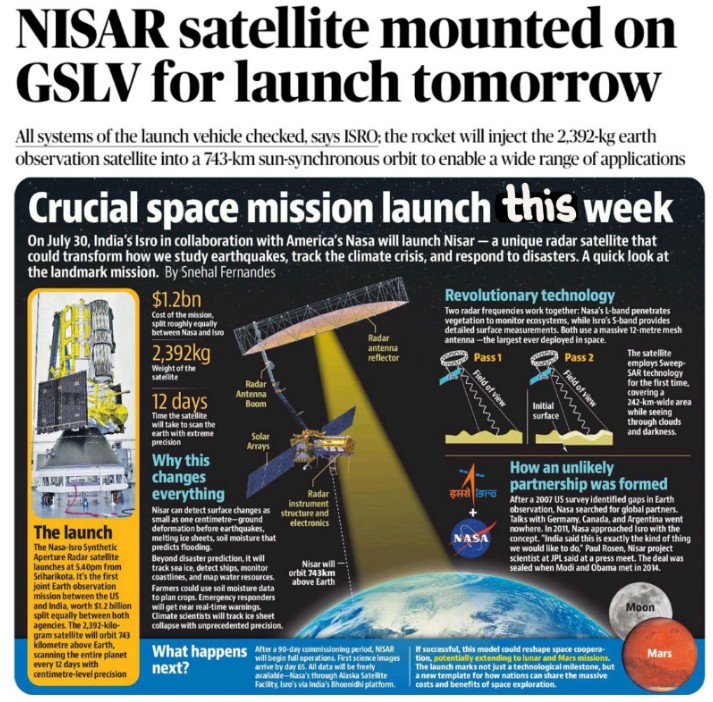
  • The NASA - ISRO Synthetic Aperture Radar(NISAR) was successfully launched from Satish Dhawan Space Centre at Sri-Harikota in Andhra Pradesh.
About NISAR Satellite

  • NISAR is an Earth-observation satellite that stands for NASA-ISRO Synthetic Aperture Radar.
  • It is Jointly developed by the National Aeronautics and Space Administration (NASA) and the Indian Space Research Organisation under a partnership agreement signed in 2014.
  • It will be launched into a polar Sun-synchronous dawn-dusk orbit at 747 km altitude and an inclination of 98.4º.
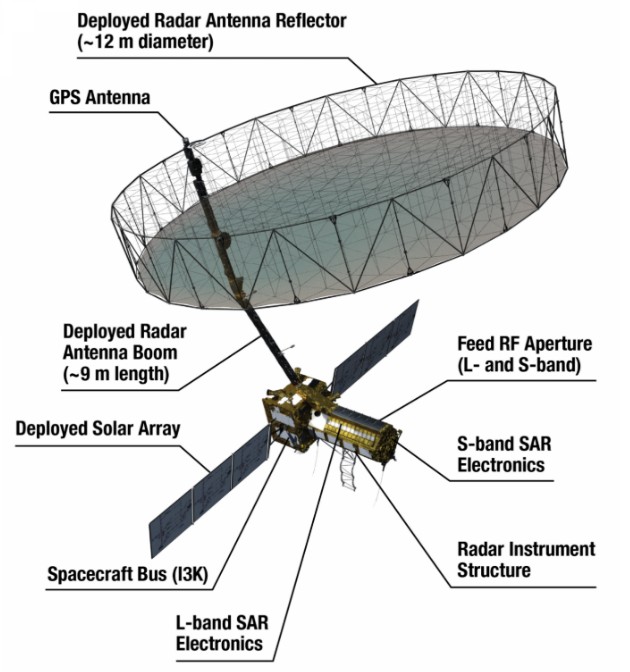
  • NISAR is the first satellite mission to collect radar data in two microwave bandwidth regions, called the L-band and the S-band.
    • The S-band payload has been made by the ISRO and the L-band payload by the U.S. 

Application of NISAR satellite

  • Solid Earth Processes – Tracking earthquakes, landslides, and land deformation.
  • Ecosystems – Monitoring forests, woody biomass, and biodiversity.
  • Ice and Snow Dynamics – Measuring glacial movements and polar ice thickness.
  • Coastal and Ocean Monitoring – Tracking shoreline erosion, oil spills, and storm surges.
  • Disaster Response – Providing near-real-time damage maps after floods, quakes, or cyclones.
  • Agriculture and Infrastructure – Supporting food security and monitoring subsidence near dams, roads, and reservoirs.

Working of NISAR

  • NISAR combines two types of Synthetic Aperture Radar (SAR) systems:
    • The L-band SAR (1.257 GHz) uses longer-wavelength radio waves that can penetrate thick vegetation and even soil, making it ideal for observing ground deformation beneath forests.
    • The S-band SAR (3.2 GHz) uses shorter-wavelength radio waves that are more effective at detecting surface details such as crops, water surfaces, and urban infrastructure.
  • The satellite also uses polarimetric radar technology, which involves sending and receiving radar signals in both horizontal and vertical polarizations.
    • Satellite operations and commanding will be managed by ISRO, while NASA will provide the orbit maneuver plan and radar operations plan. 
Objectives of the Mission

  • NISAR can measure tectonic plate movements accurately. So a lot of geological, agricultural and water-related observations can be obtained from this satellite.
  • It can study the water-stressing, climate change-related issues, agricultural changes through patterns, yield, desertification and continental movements precisely with respect to annual water cycle movements. 
  • NISAR’s data can help people worldwide better manage natural resources and hazards, as well as providing information for scientists to better understand the effects and pace of climate change. 

India - USA Contributions

  • ISRO contributed the spacecraft bus, the entire S-band radar system, Ka-band telemetry systems, and launch support via GSLV Mk-II.
  • NASA provided the L-band radar, radar structure, antenna, onboard avionics, and high-capacity data systems.

About Geosynchronous Satellite Launch Vehicle (GSLV)

  • GSLV is larger and more powerful than ISRO's Polar Satellite Launch Vehicle (PSLV). 
  • GSLV-F16 is the 18th launch of India's GSLV and 12th launch using India's cryogenic upper stage, which helps carry heavier satellites. 
  • The rocket used a 4-metre wide, dome-shaped (ogive) nose cone to protect the NISAR satellite during launch. 
  • This is the first time a GSLV rocket has placed a satellite (NISAR) into a Synchronous Polar Orbit, instead of its usual Geosynchronous Transfer Orbit. 


UPSC QEP 2026 Batch 5 - English
Buy now View Details
Submit Your Details to Learn More
I agree to give my consent to receive updates through SMS/Email & WhatsApp*.

NEEV GS + CSAT Foundation 2026/27
Buy now View Details


Join theIAShub’s Mains Answer Writing Program

Refine your answer writing skills and elevate your UPSC preparation with personalized support and expert feedback.

Fill out the form to get started with the program or any other enquiries !

I agree to give my consent to receive updates through SMS/Email & WhatsApp*.

Best IAS Coaching In Delhi, UPSC Online & Offline Classes by IAShub

Are you dreaming of becoming an IAS officer? Then, IAShub can be your best guide. It is one of the Best IAS Coaching in Delhi. Many students who want to clear the UPSC exam join IAShub for learning. The institute gives both online and offline classes. Their teachers are experienced and helpful. They easily explain every topic. Students also get notes, tests, and tips to do well in the exam.

UPSC Online Classes by IAShub

IAShub is in Delhi and is trusted by many UPSC students. It offers coaching for every part of the UPSC exam – Prelims, Mains, and Interview. The classes are simple and easy to understand. The teachers are experts and guide students in the right way. IAShub is also known for its helpful notes, test series, and answer-writing practice. IAShub is the best coaching in Delhi and also gives UPSC Online Classes. This helps students from any place in India to learn. The online classes are live and also recorded. So, students can watch them anytime. These classes cover the full UPSC syllabus.

Key Offerings Provided by IAShub

Here are some important services provided by IAShub:

  • UPSC Prelims: IAShub teaches for Prelims with a focus on basics. It also gives daily current affairs and monthly magazines.
  • Classroom Courses: IAShub has classroom learning for students in Delhi. The environment is good and peaceful for study.
  • Live Classes: Students who live far can join live UPSC online classes. These classes are just like real classes.
  • QEP for Mains: The Quality Enrichment Program (QEP) is special for Mains preparation. It helps students write better and faster.
  • Answer Writing: Regular answer writing practice is given. Teachers also check answers and give tips to improve.
  • Free Resource: IAShub gives free notes by toppers and helpful Main Booster material.
  • Test Series: Test series are available for every subject. These help students know their weak points and improve.
  • Interview Guidance Session: IAShub also gives interview practice sessions with experts. These help students feel confident.

UPSC Exam Overview

The UPSC Civil Services Exam has three parts:

  • Prelims: It has two papers: General Studies and CSAT.
  • Mains: It has nine papers, including essays and optional subjects.
  • Interview: It tests the personality and confidence of the student.

This exam is tough, but with the right guidance, it becomes easy to manage. Students must study smart and stay regular.

How IAShub Helps in the UPSC Journey

IAShub supports students from the beginning to the end. It gives the right books, tests, and notes. The classes are easy to follow, and the teachers are always ready to help. Students get personal doubt sessions too. The test series and answer checking help students learn where they need to do better. Also, free study materials save time and money.
IAShub also guides students during the final stage – the interview. Experts take mock interviews and give useful tips. This full support makes IAShub one of the best IAS coaching in Delhi.

Best IAS Coaching In Delhi FAQs

Yes, IAShub offers live and recorded online classes. Students can attend from any part of India.

Classes are available in both English and Hindi, so students can choose the language they are comfortable with.

The classroom centre is located in Delhi. Students can visit and join offline batches there.

IAShub gives interview guidance sessions to help students prepare for the final round of UPSC.