
theIAShub
06 Aug, 2025

Table of Contents

Get an Instant Call Back from Our Expert Mentors!
Context
- A devastating cloudburst in Uttarkashi’s Dharali region triggered flash floods and landslides, killing at least four people and sweeping away homes.
About the News
- At least four people died as flash floods and mudslides struck Dharali village in Uttarkashi, Uttarakhand, damaging several buildings, shops, and hotels.
- While cloudbursts are common triggers of flash floods in Uttarakhand’s hilly regions, the recent incident was not due to a technical cloudburst but rather sustained heavy rainfall over the past three days.
Factors Behind Uttrakashi Flash Floods
- Continuous rainfall over the past few days, combined with Uttarkashi’s fragile topography, triggered mudslides, debris flows, and flash floods.
- Climate change-induced intense rainfall and accelerated glacier melting further worsened the situation.
- Rainfall of any intensity, if continuous, recorded over such high altitudes where Uttarkashi is located, can be disastrous.
- That is because this region is built on layers of mudslides over the past several centuries.
- Uttarkashi district is situated along the southern Himalayan slope, where there is limited vegetation and no significant obstruction.
- Link to Climate Change: Global warming increases atmospheric moisture-holding capacity. This leads to more intense, erratic, and sudden rainfall, making cloudbursts more frequent and severe.
About Cloudburst
- A cloudburst is defined by the India Meteorological Department (IMD) as rainfall exceeding 100 mm/hour over a small area (20–30 sq km).
- These events are often associated with cumulonimbus clouds in mountainous regions, caused by orographic lift and convection Currents that rapidly accumulate moisture before collapsing violently.
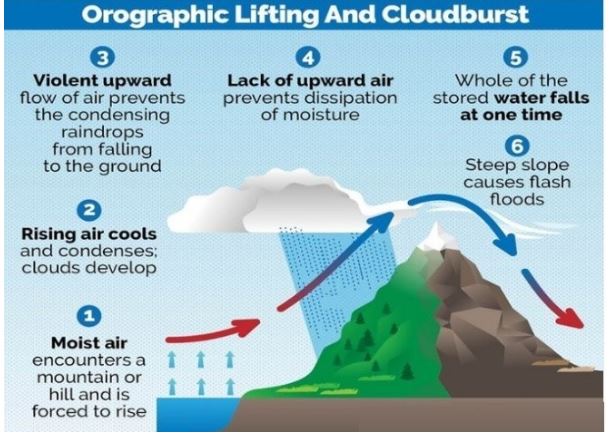
How Cloudbursts Happen
- Orographic Lift: In hilly regions, warm air currents push moisture-laden clouds upward. This upward movement (orographic lift) is a key reason cloudbursts are more frequent in mountainous terrain.
- Growth of Droplets: As clouds rise higher, water droplets grow larger and more form. Lightning within these clouds often delays rainfall, increasing moisture load.
- Sudden Downpour: When clouds can no longer hold the excess moisture, they burst, releasing intense rainfall over a small area.
Hilly Reasons are more Prone
- Due to Topography, steep slopes accelerate water runoff and debris flow.
- Moist monsoon air is rapidly lifted over hills, intensifying precipitation due to Orographic Lifting.
- Rocky Terrain causes poor water absorption and rapid accumulation on the surface.
Impact of Cloudburst
- Flash Flood: A flash flood happens quickly, when a lot of rain suddenly enters into the drainage systems (waterbodies, drains), and water overflows.
- Flash floods are more common in hills, because rocky terrain does not absorb water very well.
- Example: The 2013 Kedarnath Disaster involved a cloudburst followed by massive flash floods.
- Landslide: Landslides are a geological phenomenon that involves the sudden and rapid movement of a mass of rock, soil, or debris down a slope under the influence of gravity.
- Loss of Life and Livelihood: Sudden nature of cloudbursts leaves little time for evacuation. Destruction of homes, agricultural fields, and livestock affects livelihoods, especially in rural and tribal communities.
- Damage to Infrastructure: Roads, bridges, power lines, and communication networks are often washed away.
- Social Impact: Frequent disasters create trauma, displacement, and migration pressures. Affects education, healthcare, and access to essential services in remote regions.
Why Prediction is Difficult
- Cloudbursts occur in limited areas (10–30 sq km), making them hard to detect with standard radar systems.
- The event lasts under an hour, offering little time for forecasting and issuing effective alerts.
- Installing advanced radar and AI-based forecasting models in remote areas remains expensive and underfunded.
Measures Taken In India
- The Disaster Management Act, of 2005 provides a comprehensive legal and institutional framework for the management of various disasters in India.
- The National Institute of Disaster Management (NIDM) has been providing capacity building and other support to various national and state-level disaster management authorities.
- Early Warning system:
- India Meteorological Department (IMD), implements the Ensemble Prediction System (EPS), which uses multiple models to improve the accuracy of rainfall predictions.
- Doppler Weather Radars (DWRs): Installed in hilly and vulnerable regions to detect intense rainfall events in real-time.
- Flash Flood Guidance System (FFGS): Developed with WMO support to provide early warning for flash floods across South Asia, including India.
- Mobile-based Alert Systems: IMD and NDMA use SMS and app-based alerts to inform people in real-time.
Way Ahead
- To effectively mitigate the impact of cloudbursts, India must adopt a comprehensive and proactive approach that combines scientific forecasting, infrastructural resilience, and community-based preparedness.
- Land use planning and zoning regulations must be strictly enforced to prevent construction in high-risk zones.
- Urban and rural infrastructure should be designed to handle sudden surges in water flow, with emphasis on stormwater drainage systems, slope stabilization, and rainwater harvesting.
- Also there is a need to integrate climate change adaptation into disaster management planning as intensity of such extreme weather events has increased.
PYQs
Prelims
Q. Prelims Question 2016 GS PAPER 1 With reference to ‘cloudbursts’ consider the following statements:
1. Cloudbursts occur only during daytime.
2. Cloudbursts occur only in hilly areas.
3. Cloudbursts occur only when there is orographic uplift
Which of the statements given above is/are correct?
(a) 1 and 2 only
(b) 3 only
(c) 1 and 3 only
(d) None of the above
Ans:
Mains
Q. Mains Question 2024, MAINS, GS PAPER 1 What is a Phenomenon of CloudBurst, Explain?
Ans:

2026-27 UPSC Mains English QEP Power Pages
View DetailsSubmit Your Details to Learn More



