Changes in Periodic Labour Force Survey 2025 | Key Updates & Coverage

For Prelims:

  • PLFS 2025 revamp
  • National Statistical Office (NSO)
  • Ministry of Statistics and Programme Implementation (MoSPI)
  • Labour market estimates improvement
  • Frequency, coverage, accuracy enhancement
  • Labour Force Participation Rate (LFPR)
  • Worker Population Ratio (WPR)

For Mains:

  • First Stage Units (FSUs) increase 12,800 → 22,692
  • Households surveyed per FSU increase 8 → 12
  • First Stage Unit definition
  • 2011 census village
  • Urban Frame Survey (UFS) block
  • Usual activity status

Discover the revamped Periodic Labour Force Survey 2025 by NSO with improved methodology, monthly labour market estimates, expanded rural coverage, and enhanced sample size for accurate employment data in India.

upsc-daily-current-affairs
THEIASHUB
Get an Instant Call Back from Our Expert Mentors Now!
+91

Context

  • The National Statistical Office (NSO) has revamped the Periodic Labour Force Survey (PLFS) methodology from January 2025 to improve frequency, coverage, and accuracy of labour market estimates.

About PLFS

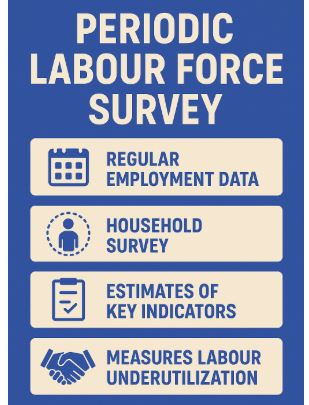
  • It is a survey conducted by the National Statistics Office (NSO) under the Ministry of Statistics and Programme Implementation (MoSPI) to estimate key employment and unemployment indicators in India. PLFS releases both monthly and annual data.
  • Monthly bulletins provide estimates of labor market indicators like Labour Force Participation Rate (LFPR), Worker Population Ratio (WPR), and Unemployment Rate (UR) in Current Weekly Status (CWS) separately for males and females. 
  • Annual report providing estimates in both usual status and CWS. 
Key Changes

Monthly Estimate Introduced

  • It will enable the generation of the monthly estimates of key labour market indicators viz. LFPR, WPR, and UR at the all-India level following the Current Weekly Status (CWS) approach. 

Quarterly Estimates Extended to Rural Areas

  • Upto December 2024, PLFS provided quarterly labour market indicators for the urban areas only. 
  • Now available for the entire country, improving rural employment data.

Enhanced Sample Size & Coverage

  • First Stage Units (FSUs) increased from 12,800 to 22,692 annually.  
  • The number of households to be surveyed within a selected geographical unit (FSU) has been increased from 8 to 12 households. 

About First Stage Unit

  • First Stage Units (FSUs) are the basic geographical units used for sample selection. 
  • In rural areas, the FSU is typically the 2011 census village (or Panchayat ward in Kerala). In urban areas, it’s the Urban Frame Survey (UFS) block. 
  • The FSUs are the initial units from which households are then selected for the survey. 

Conceptual Framework

  • Activity status of a person is determined on the basis of the activities pursued by the person during the specified reference period. 
  • Current weekly status (CWS): Activity status determined on the basis of a reference period of last 7 days preceding the date of survey.
  • Usual activity status: Activity status determined on the basis of the reference period of last 365 days preceding the date of survey
  • Labour Force Participation Rate (LFPR): LFPR is defined as the percentage of persons in the labour force (i.e. working or seeking or available for work) in the population.
  • Worker Population Ratio (WPR): WPR is defined as the percentage of employed persons in the population. 
  • Unemployment Rate (UR): UR is defined as the percentage of persons unemployed among the persons in the labour force.

Prelims:

Q. PRELIMS QUESTION
With reference to the ‘National Statistical Office (NSO)’, consider the following statements:
  1. It is an attached office under the Ministry of Statistics and Programme Implementation (MoSPI).
  2. It is responsible for conducting large-scale sample surveys in various fields, including employment and unemployment.
  3. The data it collects is used for calculating GDP and other macroeconomic indicators.
Which of the statements given above is/are correct?
A. 1 and 2 only
B. 2 and 3 only
C. 1 and 3 only
D. 1, 2 and 3

Ans:

Mains:

Q. MAINS QUESTION 2020, GS 3
Account for the changes in the employment pattern in India over the last few decades.

Ans:



UPSC QEP 2026 Batch 5 - English
Buy now View Details
Submit Your Details to Learn More
I agree to give my consent to receive updates through SMS/Email & WhatsApp*.

NEEV GS + CSAT Foundation 2026/27
Buy now View Details


Join theIAShub’s Mains Answer Writing Program

Refine your answer writing skills and elevate your UPSC preparation with personalized support and expert feedback.

Fill out the form to get started with the program or any other enquiries !

I agree to give my consent to receive updates through SMS/Email & WhatsApp*.

Best IAS Coaching In Delhi, UPSC Online & Offline Classes by IAShub

Are you dreaming of becoming an IAS officer? Then, IAShub can be your best guide. It is one of the Best IAS Coaching in Delhi. Many students who want to clear the UPSC exam join IAShub for learning. The institute gives both online and offline classes. Their teachers are experienced and helpful. They easily explain every topic. Students also get notes, tests, and tips to do well in the exam.

UPSC Online Classes by IAShub

IAShub is in Delhi and is trusted by many UPSC students. It offers coaching for every part of the UPSC exam – Prelims, Mains, and Interview. The classes are simple and easy to understand. The teachers are experts and guide students in the right way. IAShub is also known for its helpful notes, test series, and answer-writing practice. IAShub is the best coaching in Delhi and also gives UPSC Online Classes. This helps students from any place in India to learn. The online classes are live and also recorded. So, students can watch them anytime. These classes cover the full UPSC syllabus.

Key Offerings Provided by IAShub

Here are some important services provided by IAShub:

  • UPSC Prelims: IAShub teaches for Prelims with a focus on basics. It also gives daily current affairs and monthly magazines.
  • Classroom Courses: IAShub has classroom learning for students in Delhi. The environment is good and peaceful for study.
  • Live Classes: Students who live far can join live UPSC online classes. These classes are just like real classes.
  • QEP for Mains: The Quality Enrichment Program (QEP) is special for Mains preparation. It helps students write better and faster.
  • Answer Writing: Regular answer writing practice is given. Teachers also check answers and give tips to improve.
  • Free Resource: IAShub gives free notes by toppers and helpful Main Booster material.
  • Test Series: Test series are available for every subject. These help students know their weak points and improve.
  • Interview Guidance Session: IAShub also gives interview practice sessions with experts. These help students feel confident.

UPSC Exam Overview

The UPSC Civil Services Exam has three parts:

  • Prelims: It has two papers: General Studies and CSAT.
  • Mains: It has nine papers, including essays and optional subjects.
  • Interview: It tests the personality and confidence of the student.

This exam is tough, but with the right guidance, it becomes easy to manage. Students must study smart and stay regular.

How IAShub Helps in the UPSC Journey

IAShub supports students from the beginning to the end. It gives the right books, tests, and notes. The classes are easy to follow, and the teachers are always ready to help. Students get personal doubt sessions too. The test series and answer checking help students learn where they need to do better. Also, free study materials save time and money.
IAShub also guides students during the final stage – the interview. Experts take mock interviews and give useful tips. This full support makes IAShub one of the best IAS coaching in Delhi.

Best IAS Coaching In Delhi FAQs

Yes, IAShub offers live and recorded online classes. Students can attend from any part of India.

Classes are available in both English and Hindi, so students can choose the language they are comfortable with.

The classroom centre is located in Delhi. Students can visit and join offline batches there.

IAShub gives interview guidance sessions to help students prepare for the final round of UPSC.