
theIAShub
26 Jul, 2025
Table of Contents

Get an Instant Call Back from Our Expert Mentors!
Context
- The Ministry of Earth Sciences (MoES), Government of India, in collaboration hosted a national-level Brainstorming Workshop on Blue Economy Investments with its Strategic Knowledge Partner in India.
About the Workshop Developments
- The workshop aimed to promote a better understanding of three thematic domains, i.e., Trade and Investments, Startups and Innovation, and Ease of Doing Business.
- Panellists and attendees deliberated on the challenges faced by various stakeholders and collaborated to co-create multifaceted solutions, identifying and mapping investible, bankable business opportunities with the potential to unlock long-term value from the blue economy.
- The outcomes of the deliberations at the event are expected to influence the National Blue Economy Investment Strategy and inform future roadmaps for Blue Economy implementation.
About the Blue Economy: What is it?
- Gunter Pauli introduced the concept in his 2010 book, “The Blue Economy: 10 Years, 100 Innovations, 100 Million Jobs.”
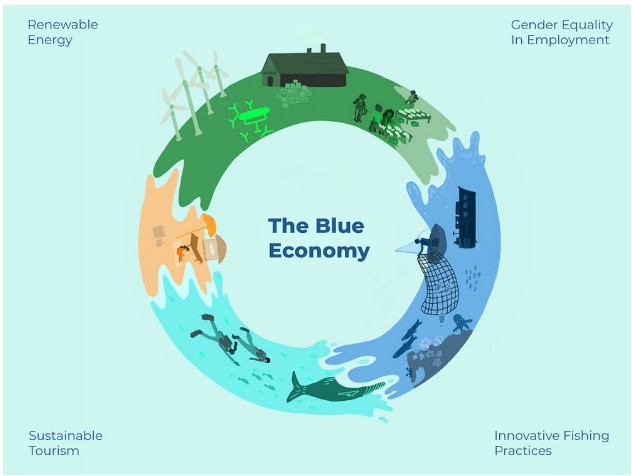
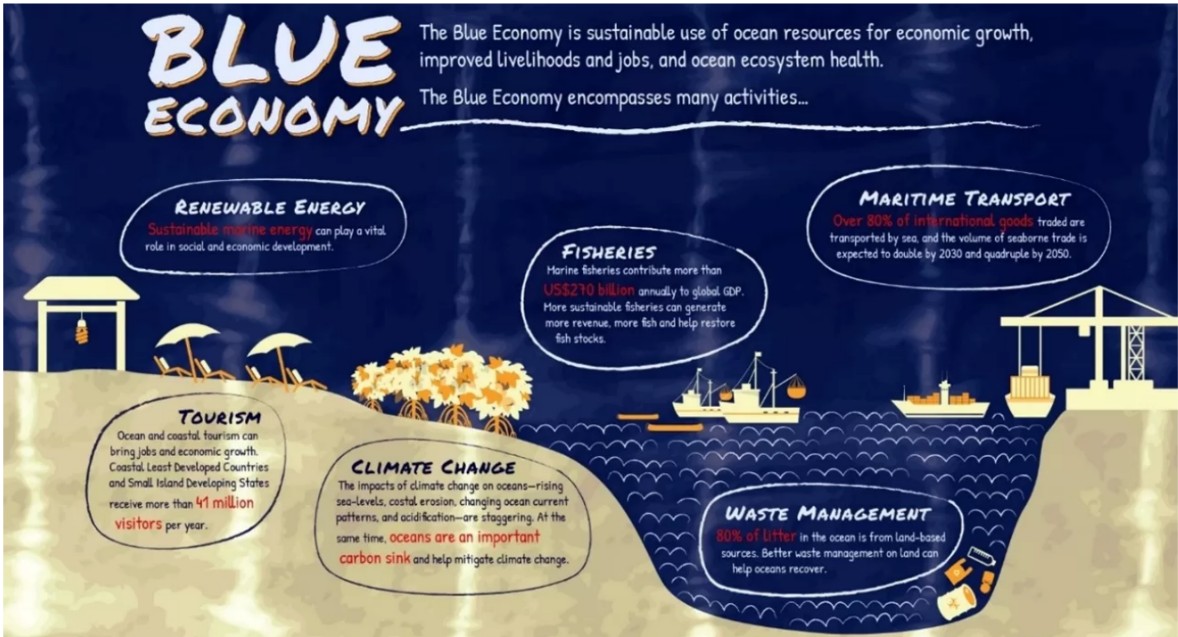
- It is the sustainable use of ocean resources for economic growth, improved livelihoods and jobs, and ocean ecosystem health.
- It highlights the importance of integrating social inclusion and innovative business models to ensure that ocean resources’ benefits are equally distributed and marine ecosystems are protected.
- This approach is encapsulated in Sustainable Development Goal (SDG Goal) 14, which calls for conserving and using oceans, seas, and marine resources for sustainable development.
Objectives of Blue Economy
- Renewable Energy – Sustainable marine energy can be vital in social and economic development.
- Fisheries – Sustainable fisheries can generate more revenue and more fish and help restore fish stocks.
- Maritime Transport – Over 80% of international goods traded are transported by sea.
- Tourism – Ocean and coastal tourism can bring jobs and economic growth.
- Climate Change – Oceans are an essential carbon sink (blue carbon) and help mitigate climate change.
- Waste Management – Better waste management on land can help oceans recover.
Blue Economy in India
- The blue economy would reinforce the Indian government’s efforts to achieve the SDGs of hunger and poverty eradication and sustainable use of marine resources by 2030.
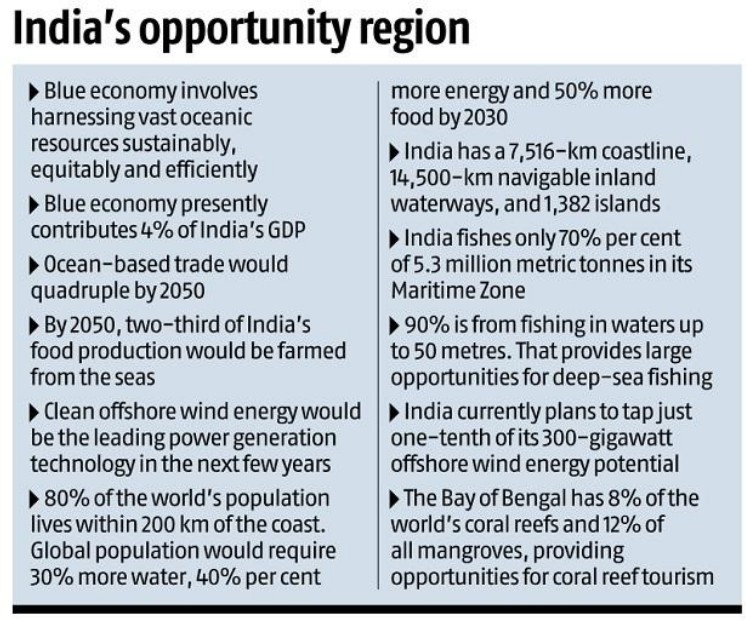
- India has a 7,517 km long coastline covering nine states and two union territories and an Exclusive Economic Zone (EEZ) of 2.02 mn. sq. km.
- The marine services sector could serve as the backbone of India’s blue economy and help the country become a 10 trillion dollar economy by 2022.
- The Indian Ocean is a significant conduit of trade, with as much as 80% of global oil trade occurring in it.
- Better regional connectivity will significantly cut transport costs and maritime resource wastage, making trade sustainable and cost-effective.
- This economy focuses on livelihood generation, achieving energy security, building ecological resilience, and improving coastal communities’ health and living standards.
Importance of Blue Economy
- Economic Growth – It drives significant economic benefits through fisheries, maritime transport, tourism, and renewable energy sectors.
- The sustainable use of ocean resources can boost economies, create jobs, and generate revenue.
- Environmental Sustainability – The Blue Economy helps preserve marine ecosystems, protect biodiversity, and mitigate the impacts of climate change by promoting the sustainable management of ocean resources.
- It focuses on reducing pollution and overexploitation.
- Food Security – Sustainable fisheries and aquaculture are vital for global food security.
- The Blue Economy ensures that fish stocks are managed effectively, contributing to a stable food supply and supporting coastal communities.
- Climate Change Mitigation – Oceans act as a major carbon sink, absorbing a significant amount of CO2.
- The Blue Economy supports initiatives that enhance the ocean's ability to sequester carbon and adapt to climate change impacts.
- Innovative Solutions – It encourages the development of innovative technologies and practices, such as renewable marine energy and advanced waste management systems, which contribute to a circular economy and reduce environmental footprints.
Challenges to Blue Economy
- Threat of Sea- Borne Terror- Piracy and armed robbery, maritime terrorism, illicit trade in crude oil, arms, drug and human trafficking, and smuggling of contraband, etc.
- Natural Disasters – Every year, tsunamis, cyclones, hurricanes, typhoons, etc., leave thousands of people stranded and property worth millions destroyed.
- Man-Made Problems – Oil spills and climate change continue to risk the stability of the maritime domain.
- Impact of Climate Change – Changes in sea temperature and acidity threaten marine life, habitats, and the communities that depend on them.
- Marine Pollution – Excess nutrients from untreated sewage, agricultural runoff, and marine debris such as plastics.
- Overexploitation of Marine Resources – Illegal, unreported, and unregulated extraction of marine resources.
Developments Initiated by India
- The Sagarmala project is a strategic initiative for port-led development, which involves extensive use of IT-enabled services to modernise ports.
- India has an umbrella scheme by the name of O-SMART (‘Ocean Services, Modelling, Application, Resources and Technology), which is aimed at promoting ocean research and setting up early warning weather systems with the objectives of providing forecasts and services based on the continuous observation of oceans, development of technologies and exploratory surveys for sustainable harnessing of oceanic resources (both living and non-living) and promotion of front-ranking research in ocean sciences.
- Integrated Coastal Zone Management focuses on conserving coastal and marine resources and improving livelihood opportunities for coastal communities.
- The development of Coastal Economic Zones (CEZ) under Sagarmala would become a microcosm of the blue economy, wherein industries and townships that depend on the sea would contribute to global trade.

2026-27 UPSC Mains English QEP Power Pages
View DetailsSubmit Your Details to Learn More



