
theIAShub
29 Jul, 2025

Article List
1. Dudhwa Tiger Reserve: Leopard Population Soars by 198% | Key Facts & Wildlife
Context
- Recently Leopard Population soared to 198% in Dudhwa Tiger Reserve.
- In the Dudhwa buffer zone, which also houses several human habitats, the wild cat population grew by 142.86%.
- Leopards, whose number in Dudhwa National Park (DNP) grew to 93 in 2025 from 34 in 2022 (173.53%), in the Katarniaghat sanctuary to 131 from 37 in 2022 (254.05%) and in the buffer zone to 51 from 21 in 2022 (142.86%).
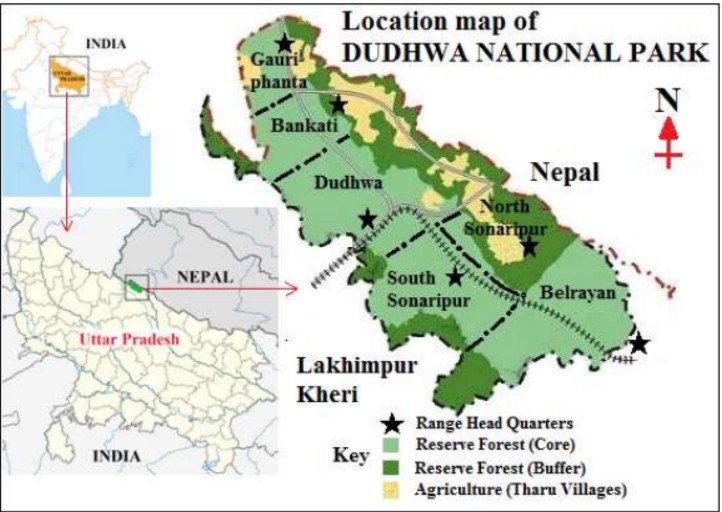
About Dudhwa Tiger Reserve
- It is located in the Lakhimpur-Kheri district of Uttar Pradesh with an area of 614 sq km.
- It is one of the finest examples of the exceedingly diverse and productive Terai eco-systems.
- Terai Arc Landscape (TAL) is composed of 14 Indian and Nepalese trans-border protected ecosystems of the Terai and nearby foothills of the Himalayas and encompassing 14 protected areas of Nepal and India.
- It has an area of approximately 12.3 million acres and includes Nepal’s Bagmati River to the east and India’s Yamuna River to the west.
- The northern edge of the reserve is marked by the river Mohana which lies along the Indo-Nepal border while the southern boundary is marked by the river Suheli.
- It is home to a large number of rare and endangered species, which include tiger, leopard, swamp deer, hispid hare, Bengal floricans, etc.
- It comprises three protected areas of Kishanpur Wildlife Sanctuary, Katarniaghat Wildlife Sanctuary and Dudhwa National Park.
Flora
- Northern Tropical Semi-Evergreen Forest, Northern Moist Deciduous Forests, Damar Sal Forests, Moist Bhabar Sal, Western light and Alluvial Plains Sal, Chandar Sal, Terminalia tomentosa Forests, Low Alluvial Savannah Woodland, Dry Plain Sal Forests, Moist Sal Savannah Forests, Tropical Seasonal Swamp Forests, Khair Sissoo Forests, plantations of exotic and indigenous species.
Fauna
- It is the only place in the country to hold a potentially viable population of the nominate subspecies of the northern swamp deer (Cervus duvauceli duvauceli).
- It is also home to a sizable tiger population and some Critically Endangered species such as the Bengal Florican (Houbaropsis bengalensis) and Hispid Hare (Caprolagus hispidus).
- It is also the place where the Great Indian One-Horned Rhinoceros was successfully reintroduced in the year 1984.
- Thirteen species of mammals, nine species of birds, and eleven species of reptiles and amphibians found here are considered to be “Endangered” in the IUCN Red List and are listed in Schedule I of the Wildlife (Protection) Act, 1972.
2. NHPC’s Mega Solar Power Project in Uttar Pradesh | Jalaun Solar Park Details
Context
- Recently, NHPC announced tenders for a major solar power project at Jalaun Solar Park, Uttar Pradesh.
About the News
- It has been launched under the Ultra Mega Renewable Energy Power Parks (UMREPP) initiative, this solar park is being developed by Bundelkhand Saur Urja Limited (BSUL)—a joint venture between NHPC Ltd. and UPNEDA.
- The total estimated investment is approximately ₹796.96 crore, which includes ₹42.7 crore in interest during construction and ₹239.1 crore in equity from NHPC into BSUL
- Once it becomes operational, it's expected to generate 2,400 million units (2.4 billion kWh) annually and be fully operational within 24 months of investment approval.
Renewable Integration and Storage
- As per the Project and under the Request for Selection (RfS)/PPA, developers must incorporate energy storage systems (ESS): typically 50% storage capacity
- For Example 600 MW/1200 MWh for full 1200 MW projects, with scalable minimum configurations (e.g. 50 MW + 25 MW ESS).
Strategic Significance
- The Jalaun project aligns with NHPC’s shift toward renewables—part of its portfolio alongside hydro, wind, and solar generation forms of energy.
- It is one of several mega solar parks planned under NHPC/BSUL, including smaller projects such as the 600 MW Madhogarh and 100 MW Mirzapur-Jagir park in UP.
- Uttar Pradesh aims to expand its solar capacity dramatically by targeting over 20 GW by 2026–27.
- As of late 2023, UP had only ~2,632 MW installed power projects and making this mega-park will be a pivotal development in its renewables strategy.
Solar capacity and Plants in Uttar Pradesh
- Solar capacity surged from approximately 288 MW in 2017 to ~2,653 MW by March 2025, showing a near tenfold increase in solar capacity.
- As of early 2025, around 1,100 MW are operational across 17 ground-mounted solar plants.
- The Sector has also created around 7500 hunf\dred jobs in this sector.
State targets and Policy Directions
- The state aims to achieve 2,200 MW by 2027 under Solar Energy Policy‑2022.
- The State also aims to achieve 22,000 MW by 2027, and even a long‑term 500 GW target by 2030 supported through MoUs with international partners.
- The state launched tenders to build ~440 MW floating solar across six water bodies; plans eventually include 10,000 MW of reservoir-based solar.
- Solar Along Infrastructure: Feasibility studies underway to install 450 MW solar along Bundelkhand Expressway.
Key Projects and Regions
Bundelkhand Solar Hub
- State Government has initiated projects totaling 4,000 MW in districts like Jhansi, Chitrakoot, Lalitpur, and Jalaun.
- Flagship plants include:
- 600 MW Jhansi Solar by TUSCO (operational Jan 2025).
- 100 MW Fourth Partner Energy in Babina .
- 135 MW Sun Source Energy project.
Industrial Solar Zones
- UPSIDA approved 13 solar plants across key industrial clusters (Ghaziabad, Kanpur, Moradabad, etc.), including a model 150 kW plant in Kanpur.
3. Miyawaki Forest Inaugurated at ABVMU Lucknow by UP Governor Anandiben Patel
Context
- Uttar Pradesh Governor and Chancellor Anandiben Patel inaugurated a Miyawaki forest at Atal Bihari Vajpayee Medical University (ABVMU) in Lucknow and participated in a sapling plantation drive.
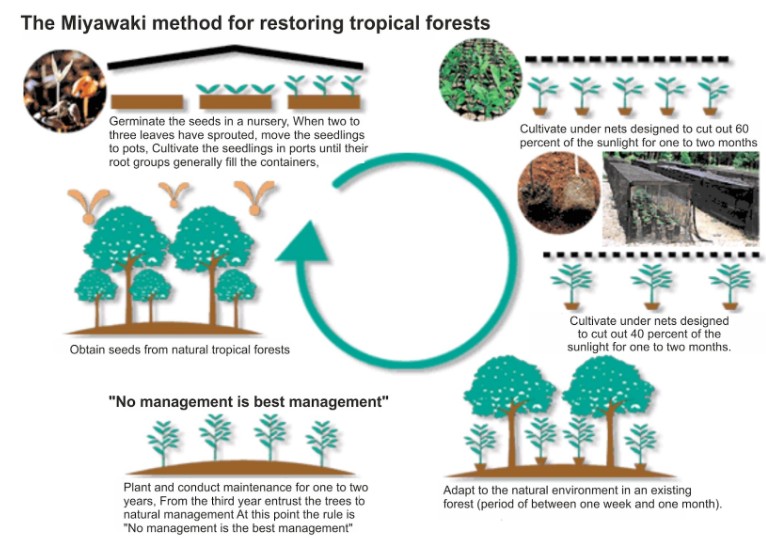
About Miyawaki Forests/Plantation Method
- It was developed by renowned Japanese botanist Akira Miyawaki in the 1970s.
- It is a revolutionary method for creating dense forests in limited spaces.
- It is often referred to as the ‘pot plantation method’, it involves planting trees and shrubs close to one another to accelerate their growth. Plants grow 10 times faster with this technique, making it a practical solution for urban areas.
- This method mimics natural forests by using a mix of native species planted densely.
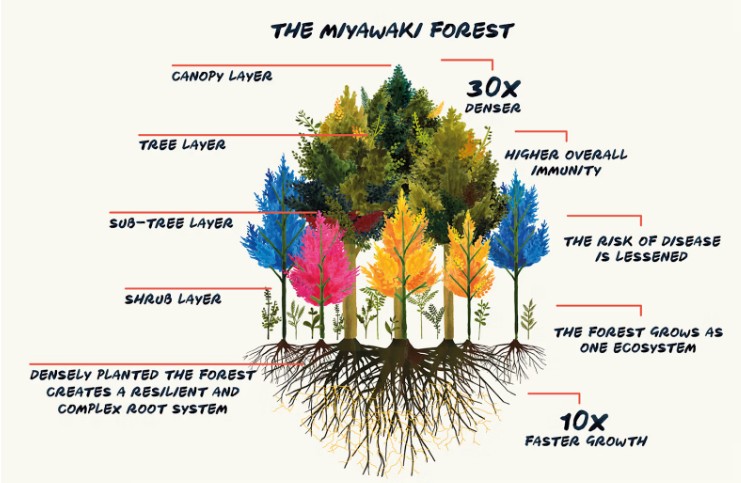
Miyawaki Plantation Advantage
- It improves soil quality, enhances biodiversity, and accelerates forest development.
- Trees planted using the Miyawaki technique absorb more carbon, grow faster, and support richer biodiversity compared to traditional forests.
- In urban settings, this technique has transformed polluted, barren lands into green ecosystems.
- It has successfully managed industrial waste, reduced dust and foul odours, and curbed air and water pollution.
- Additionally, it prevents soil erosion and promotes ecological balance, making it an effective tool for environmental restoration.
- The dense green cover of indigenous trees plays a key role in absorbing the dust particles of the area where the garden has been set up. The plants also help in regulating surface temperature.
- Some of the common indigenous plants that are used for these forests include Anjan, Amala, Bel, Arjun, and Gunj.
- These forests encourage new biodiversity and an ecosystem, which in turn increases the fertility of the soil.

2026-27 UPSC Mains English QEP Power Pages
View DetailsSubmit Your Details to Learn More



