
1. Global Alliance for Mass Entrepreneurship (GAME)
Global Alliance for Mass Entrepreneurship (GAME) : Recently, the Global Alliance for Mass Entrepreneurship (GAME) collaborated with NITI Aayog to strengthen entrepreneurship ecosystems in several states across India.
- Partnership Focus: GAME and NITI Aayog will launch pilot projects in cities like Nagpur, Visakhapatnam, and regions in Uttar Pradesh, focusing on community-driven, location-based entrepreneurial solutions.
- Building Local Solutions: The collaboration brings together local stakeholders—government, corporates, educational institutions, financial organizations, and community groups—to provide region-specific solutions addressing unique local challenges.
- Empowering Entrepreneurs: The partnership will use a bottom-up approach, fostering sustainable entrepreneurship by working closely with local entrepreneurs and stakeholders.
- About GAME: Founded in 2018 to create a nationwide movement for entrepreneurship, tackling various challenges faced by entrepreneurs in India. Major initiatives :
o Supporting women entrepreneurs with better resources and opportunities
o Helping MSMEs build robust business models and expand operations
o Promoting sustainable business practices for long-term growth
o GAME has assisted over 300,000 entrepreneurs through interventions like: Credit access, Market linkages and Localized support initiatives.
2. Flue Gas Desulfurisation
Flue Gas Desulfurisation : Recently, the SC of India issued a directive to send notices to nine thermal power plants, including two managed by Punjab State Power Corporation Ltd (PSPCL), regarding the installation of Flue Gas Desulfurisation (FGD) units.
- About FGD: Used to remove sulphur compounds, especially sulfur dioxide (SO₂), from the exhaust emissions of fossil-fuelled power stations.
o The process uses alkaline absorbents like ammonia, sodium sulphite, lime, or limestone slurry to chemically capture SO₂, removing up to 95% from flue gas.
o The wet process is the most common method, where flue gases are saturated with absorbents in aqueous solution.
o In wet limestone scrubbing, flue gas is sprayed in a scrubber tower with a water-limestone mix that reacts with SO₂.
3. National Ayush Mission (NAM) Conclave 2025
National Ayush Mission (NAM) Conclave 2025 : Recently, NAM Conclave 2025 concluded with a strong push from States and UTs to strengthen public health infrastructure and improve service delivery under India's traditional medicine systems.
- About NAM: A centrally sponsored scheme launched by the Ministry of AYUSH in 2014.
It aims to promote the development, education, and widespread adoption of India’s traditional medicine systems—Ayurveda, Yoga & Naturopathy, Unani, Siddha, Sowa-Rigpa, and Homoeopathy.
- Key Objectives: Enhance access to AYUSH healthcare services
o Encourage the cultivation of medicinal plants used in these systems
o Strengthen AYUSH educational institutions
o Raise awareness about the benefits of AYUSH practices
4. Enhancing Competitiveness of MSMEs in India Report
Enhancing Competitiveness of MSMEs in India Report: Recently, NITI Aayog, in collaboration with the Institute for Competitiveness, released a report titled "Enhancing MSMEs Competitiveness in India" to boost the sector’s growth.
- Major Findings :
o Better Access to Credit: More MSMEs are getting formal loans, but there is still a big gap, with only 19% of credit needs being met.
o Issues with CGTMSE: The Credit Guarantee Fund (CGTMSE) has grown but needs improvements to provide better services to MSMEs.
o Lack of Skills: Many workers in MSMEs don't have formal training, which affects productivity. There is also not enough focus on research and new ideas.
o Tech Challenges: MSMEs struggle to adopt modern technology due to poor infrastructure and high costs.
o Sector-Specific Issues: Sectors like textiles, chemicals, automotive, and food processing need to update technology and improve marketing.
o Policy Issues: Many MSMEs don’t know about government policies meant to help them, so these policies aren’t very effective. There needs to be better implementation at the state level.
o Suggestions: MSMEs should focus on digital marketing, work with logistics companies, and create better market connections, especially in growing areas like northeast and east India. States should have flexible policies to support MSMEs.
5. Bagram Airfield
Bagram Airfield : Recently, the U.S. President claimed China occupies Bagram Airfield which was vacated by U.S. forces in 2021. However, the Taliban denied any Chinese presence, asserting full control over the base.
- About Bagram: Located in Parwan province, 60 km north of Kabul, Bagram is Afghanistan’s largest airbase.
oProvides strategic access via the Salang Pass and major highways connecting all parts of the country.
oServed as the central hub for U.S. military operations in Afghanistan.
- Timeline of Control:
o1950s: Built by the Soviets.
o1979–89: Used extensively during the Soviet-Afghan war.
o1990s: Fell into disrepair, contested by the Taliban and Northern Alliance.
o2001–2021: Revived and expanded by the U.S. as a major operational hub.
oJuly 2021: U.S. forces vacated Bagram.
oAugust 15, 2021: Taliban took control.
6. De-Extinction
De-Extinction: Recently, the concept of de-extinction has sparked a contentious debate,especially following the announcement by Colossal Biosciences Inc. that it had revived a species last seen 13,000 years ago.
- About De-extinction: The scientific process of bringing back extinct species using their genetic material, typically through gene editing and cloning.
o It involves reconstructing the genome of an extinct species and altering the DNA of a closely related living organism to resemble the extinct species.
o IUCN’s View: According to the International Union for Conservation of Nature (IUCN), de-extinction should be seen as creating proxies of extinct species, not fully replicating the original.
o Proxies: These are organisms that resemble extinct species genetically but may not match the original in behavior or physiology.
- Larger Issue of De-Extinction
o Key Concern: Is creating proxies for extinct species through genetic engineering equivalent to fully reviving the original species with all its characteristics?
o Ethical & Ecological Implications: The process raises ongoing debates on the ethics and ecological impact of biotechnological advancements.
o Conservation & Biodiversity: The discussion raises questions about the true goals of conservation and biodiversity protection.
o Human Intervention: The role of human intervention in nature is questioned, particularly in the context of a rapidly changing environment.
7. Amnesty International's Annual Report
Amnesty International's Annual Report : Recently, Amnesty International's annual report for 2024/25 highlighted severe global human rights challenges, particularly in Africa.
- About Report: The report, titled "The State of the World's Human Rights," points to the growing threats of inequality, climate change, and gender-based violence, which continue to undermine the stability and future of millions.
oIt also sheds light on the human cost of political, environmental, and social failures, addressing both regional and global trends.
- Key Findings :
o Conflict & State Violence: Countries like Burkina Faso, Cameroon, and CAR saw unlawful attacks by state forces and armed groups.
o Gender-Based Violence: Over 11,000 cases of conflict-related sexual violence reported in CAR in early 2024, with similar issues in Somalia and South Sudan.
o Poverty & Hunger: Rising food and fuel prices pushed millions into poverty, with severe droughts in Southern Africa worsening food insecurity.
o Climate Displacement: Sudan had the largest displaced population, with other countries like DRC and Somalia also facing high displacement due to climate-related disasters.
o Global Inaction: Amnesty criticized wealthy nations for inadequate climate funding and leaving vulnerable communities to suffer.
o Sustainable Debt Issues: Many African nations faced unsustainable debt, hindering effective climate policies despite securing climate funding.
8. Mt. Makalu and Mt. Annapurna
Mt. Makalu and Mt. Annapurna: The Indo-Tibetan Border Police (ITBP) has successfully scaled Mt. Makalu (8,485 meters) and Mt. Annapurna (8,091 meters) as part of the International Mountaineering Expedition.
- About Mt. Makalu: The fifth highest mountain in the world, known for its perfect pyramid shape with four sharp ridges.
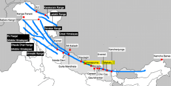
o Located in the Mahalangur range of the Nepal Himalayas, on the border between Nepal and Tibet, 14 miles (23 km) southeast of Mount Everest.
o Makalu Barun National Park: The mountain lies within this park, home to Barun Valley, stunning waterfalls, diverse flora and fauna, and the cultures of Sherpa and Kirat communities.
o Climbing Difficulty: Considered one of the hardest eight-thousanders due to its steep pitches, knife-edged ridges, and technical rock climbing required for the final ascent.
- About Mt. Annapurna: The world’s tenth-highest peak, known as the “Killer Mountain” due to its high fatality rate among climbers.
o Located in the Annapurna Range of Gandaki Province, north-central Nepal.
o Conservation: Part of the Annapurna Conservation Area, which spans 7,629 square kilometers.
9. Largest Battery-Powered Ship
Largest Battery-Powered Ship: Recently, Australian boat builder Incat launched the world's largest battery-powered ship Hull 096, marking a significant milestone in the development of electric-powered vessels.
- About Hull 096: A 130-meter (426 feet) aluminum catamaran designed to carry 2,100 passengers and up to 225 vehicles.

o Propulsion: Uses eight electric-driven waterjets for efficient movement.
o Environmental Impact: A significant step in reducing emissions from the shipping industry, which contributes 3% of global greenhouse gases.
o Shift to Electrification: Initially planned for LNG, the vessel now uses electric propulsion, aligning with eco-friendly transport trends.

2026-27 UPSC Mains English QEP Power Pages
View DetailsSubmit Your Details to Learn More



