
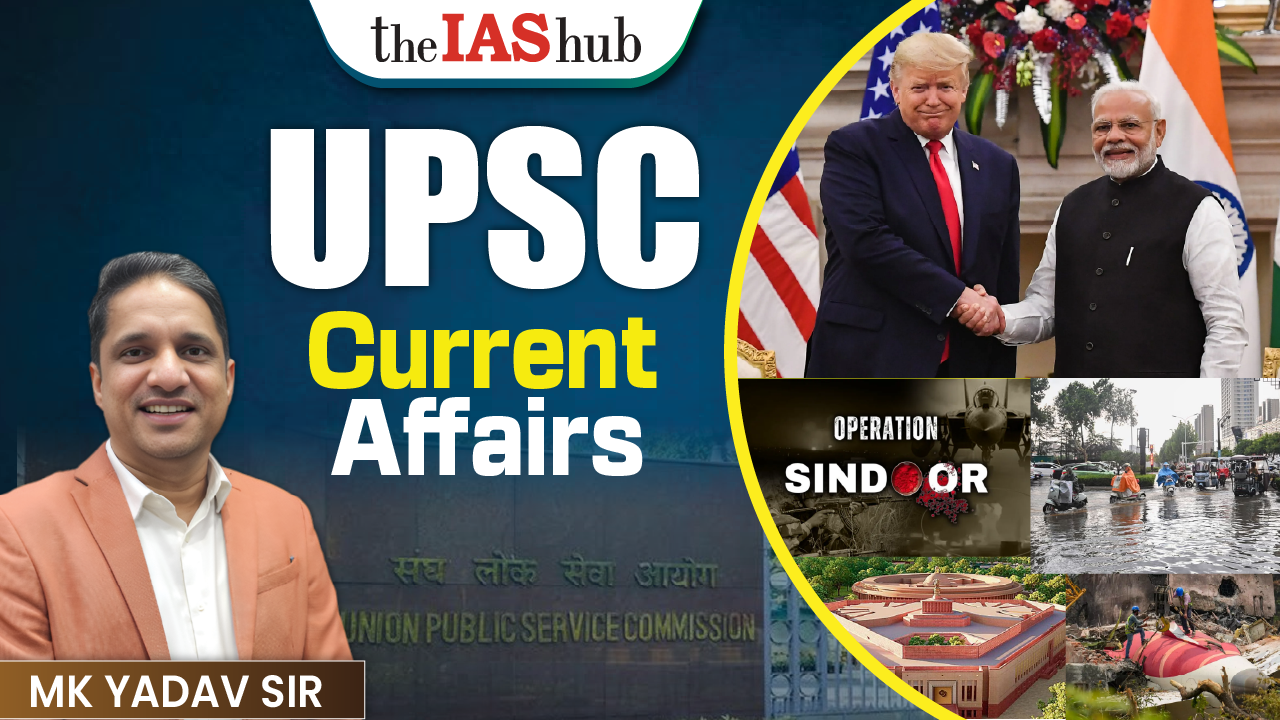
1. India-Middle East-Europe Economic Corridor (IMEC)
India-Middle East-Europe Economic Corridor (IMEC): This agreement presents a tremendous opportunity for US-India to strengthen their partnership and promote their strategic interests.
- About IMEC: Launched in 2023, aims for an integrated network across three regions.
- Key goals: Efficient transport, energy security, technological innovation.
- Benefits: Free trade routes, reduced costs, diversified supply chains.
- Evolution of U.S.-India Ties: Stronger strategic partnership since Clinton's 1990s era.
o Bipartisan support in the U.S. to strengthen economic, security, and democratic collaboration.
- The Role of the U.S. & India: U.S. leadership can solidify the partnership, balancing global economic structures against China’s Belt and Road Initiative (BRI).
o Strengthening ties with participating nations like the UAE, Saudi Arabia, Italy & Germany.
- Infrastructure Challenges: Requires massive infrastructure investments competing with other national priorities.
o Private sector involvement is essential for its success.
- Key Contributors: France, appointed business leader Gérard Mestrallet as special envoy to lead IMEC.
o UAE & Saudi Arabia: Driving forces for advancing IMEC.
- Economic & Strategic Advantages for India: Reduces trade costs, transforms maritime logistics.
o Opens new opportunities for FDI & Strengthens diplomatic ties with West Asia and Europe.
- Environmental Implications: India’s role in green hydrogen production can reduce carbon emissions and dependence on fossil fuels.
2. Mercy Petition
Mercy Petition: The Supreme Court recently granted the Centre a final chance to decide on the mercy plea of Balwant Singh Rajoana, convicted for assassinating Punjab CM Beant Singh. If the Centre fails, the court will hear Rajoana's plea to reduce his death sentence.
- About: A mercy petition is a request to the President of India or a state Governor to pardon a convict or commute their sentence. It is the last constitutional option a convict can take after being sentenced by a court of law.
- Case Background: Rajoana was sentenced to death in 2007 for the assassination of Punjab CM Beant Singh and 12 others (August 31, 1995).
o Mercy petition filed by the Shiromani Gurdwara Parbandhak Committee in March 2012.
- Constitutional Framework: As per the Article 72, the President can grant pardons, reprieves, respites, remissions, or commute sentences in cases of punishments by Court Martial, offences under Union laws, and death sentences.
o Article 161: The Governor can exercise similar powers for offences under State laws but cannot pardon death sentences or Court Martial punishments.
- Features: No time limit for mercy petitions under Articles 72 and 161.
o Acceptance of mercy petitions is not binding on the President or Governors.
- Key Differences:
o President: Can pardon Court Martial punishments and death sentences.
o Governor: Cannot pardon these categories.
- Process: No statutory procedure exists.
o Petition can be filed by the convict or their relative within seven days of Supreme Court appeal dismissal.
o Petition is forwarded to the Ministry of Home Affairs (MHA) for recommendations.
o MHA consults the concerned State Government before advising the President or Governor.
- Decision-making: Executive heads act based on the advice of the appropriate government.
3. Colossal Discoveries at Ratnagiri
Colossal Discoveries at Ratnagiri: ASI unearthed a colossal Buddha head (3-4 feet), a giant palm (5 feet), an ancient wall, and inscribed relics dating back to the 8th-9th Century AD that highlights Ratnagiri's significance as a Buddhist learning center rivaling Nalanda.
- About Historical Context: Buddhism in Odisha dates back to Emperor Ashoka's invasion of
Kalinga (261 BCE), which led to his conversion to Buddhism.
o Kalinga's trade links popularized Buddhism across Southeast Asia.
- Ratnagiri - A Center of Learning: Active between the 5th and 13th centuries, with construction peaking in the 7th-10th centuries.
o Known for Mahayana and Tantrayana sects, it once rivaled Nalanda in Buddhist scholarship.
o Possibly visited by Hiuen Tsang (638-639 AD) during his Odisha travels.
- Previous Excavations: Early excavations (1958-61) uncovered a brick stupa, three monastic complexes, and hundreds of stupas.
o Led by archaeologist Debala Mitra, the findings emphasized Ratnagiri's historical richness.
- Renewed Excavations: ASI aims to explore partially visible structures, ceramic assemblages, and possible chaitya complexes.
o Focus on studying the cultural and material links with Southeast Asia.
- Odisha's Maritime Legacy: Ancient Kalinga traded spices, silk, gold, and other goods with regions like Bali, Java, Sumatra, Sri Lanka, and Myanmar.
o The annual Baliyatra festival commemorates these 2,000-year-old links.
- Flourishing Buddhism under Bhaumakaras: Buddhism thrived during the 8th-10th century under the Bhaumakara dynasty, with Ratnagiri as a major hub.
- Ratnagiri - A Center of Learning: Active between the 5th and 13th centuries, with construction peaking in the 7th-10th centuries.
4. Indian Coffee
Indian Coffee: In the first half of January 2025, India Exported 9,300+ tonnes of coffee with top buyers including Italy, Belgium, and Russia.
- About: Coffee introduced in India by Baba Budan in the 1600s, planting seeds in Baba Budan Giri (Karnataka).
o India ranks as the 7th largest coffee producer, exporting $1.29 billion (FY 2023-24), up from $719.42 million (2020-21).
- Rising Domestic Consumption: Shift to coffee due to cafe culture, higher incomes, and changing preferences.
- Major regions: Grown in biodiversity-rich Western & Eastern Ghats; key producers Karnataka - 248,020 MT (2022-23), Kerala & Tamil Nadu.
o Top Producer: Karnataka contributes over 70% of India's total coffee output.
- Integrated Coffee Development Project (ICDP): Focus on yields, expansion to non-traditional regions, and sustainability.
o For example, Araku Valley—20% production growth through tribal collaboration and GCC loans, benefiting 150,000 families.
- About Coffee Production: Coffee mainly includes Coffea Arabica (Arabica) and Coffea Canephora (Robusta).
- Climatic Conditions for Coffee Cultivation: Requires 15°C to 28°C of temprature.
o Rainfall: Needs 150-250 cm annually.
o Soil: Prefers well-drained loamy soil rich in humus, iron, and calcium.
o Shade Requirement: Grows under shady trees.
o Ripening Condition: Requires dry weather for berry ripening.
o Elevation: Thrives at 600-1,600 m above sea level on hill slopes.
5. Entity Locker
Entity Locker: The National eGovernance Division (NeGD), under the Ministry of Electronics and Information Technology (MeitY) has developed Entity Locker, a cutting-edge digital platform designed to transform the management and verification of business/organisation documents.
- About the Features of Entity Locker:
o Cloud-Based Solution: Secure storage, sharing, and verification for businesses, MSMEs, startups, societies, etc. 10 GB encrypted cloud storage for document safety.
o Real-Time Access: Integration with government databases ensures instant document verification.
o Consent-Based Sharing: Secure and accountable sharing of sensitive information.
o Aadhaar-Authenticated Access: Role-based access to ensure accountability.
o Digital Signature Support: Legally valid signatures for document authentication.
6. International Conference on Sustainable Circularity
International Conference on Sustainable Circularity: Recently, the Union Minister for Environment, Forest and Climate Change, GOI, addressed the 3rd International Conference on Sustainable Circularity, organized by the Society of Indian Automobile Manufacturers (SIAM).
- About: SIAM focuses on activities related to improvement of environment and ensuring safety and protection of automobile vehicle users and public at large that granted registration under the Income Tax Act, 1961.
- About the Theme & Context: Conference on ‘Nature Positive Recycling’, alien to focus on sustainable development and circularity in the automotive sector.
- Government Policies Supporting Sustainability:
o Vehicle Scrappage Policy (2021): Mandates fitness tests for old vehicles and promotes BS-VI-compliant replacements.
ü Projected to reduce 17% NOx and 11% PM2.5 emissions from trucks.
o End-of-Life Vehicles (ELVs) Rules (2025): Effective April 1, 2025, ensuring EPR compliance and proper vehicle scrapping in registered facilities.
o Electric Vehicle (EV) Promotion: FAME & PLI schemes: Boost EV adoption, with sales expected to hit 35% by 2030, reducing 5 metric tonnes of CO2 emissions annually.
o Automotive Industry’s Role in SDGs: Contributing to SDG 7 (Clean Energy), SDG 8 (Decent Work), and SDG 9 (Innovation & Infrastructure).
ü Transitioning to renewable energy to minimize EV battery charging impact.
- Industry Expectations: Lead the transition to circular economy through Recyclable designs, Sustainability in dealership operations, and Consumer awareness campaigns.
- Key Initiative & Afforestation Campaign: Participation in ‘Ek Ped Ma Ke Naam’ to combat air pollution via afforestation.
7. Lead Poisoning
Lead Poisoning: As per the WHO estimate nearly 1 million people die annually from lead poisoning.
- About: Lead is a chemical element with properties like soft, heavy, gray metal that is malleable and corrosion-resistant. It occurs when lead enters the air, water, soil, and buildings.
o UNICEF warns that 800 million children face intellectual disabilities and behavioral disorders due to lead exposure.
- Common Sources of Lead: Adulterated turmeric, paint, cosmetics (like kajal), traditional medicines, ceramic pottery glazes, cheap cookware, water pipes, and recycled batteries.
- Diseases caused by lead poisoning: Anemia, hypertension, kidney impairment, and reproductive organ toxicity

2026-27 UPSC Mains English QEP Power Pages
View DetailsSubmit Your Details to Learn More



