The Silent Epidemic

India faces a growing obesity crisis, with widespread household clustering increasing risks of cancer and NCDs. Urgent focus on family-based interventions, policy reforms, and urban planning is essential to tackle this public health and economic challenge.

editorial-analysis
THEIASHUB
Get an Instant Call Back from Our Expert Mentors Now!
+91

Context

  • India’s health landscape is undergoing a significant shift from battling undernutrition to confronting an alarming rise in obesity-related disorders. Recent data reveal widespread household clustering of obesity, increasing the risk of non-communicable diseases, especially cancer, and posing a new public health and economic challenge.

Background

  • India is witnessing a nutritional transition, with 20% of households having all adults overweight and 10% fully obese.
  • Obesity, once linked to affluence, is now widespread and clustered within families, especially in urban areas and states like Tamil Nadu and Punjab.
  • This trend is not just a lifestyle issue but a serious health threat, closely linked to cancer, cardio-metabolic diseases, and hormonal imbalances.

National Programme for Prevention and Control of NonCommunicable Diseases (NP-NCD)

  • Launch: Initiated in 2010 in 100 districts across 21 states under the 11th Five Year Plan.
  • Expansion: Phased scaling proposed during the 12th Five Year Plan to cover all districts.
  • Integration: In 2013-14, merged under the National Health Mission (NHM) for broader healthcare delivery. 
  • Objectives: Health Promotion: Encourage behavior change through community, civil society, media engagement.
  • Early Detection & Continuum of Care: Focus on screening, diagnosis, management, and follow-up at all levels.  
  • System Strengthening: Includes capacity building, robust supply chain for drugs/equipment, and uniform ICTbased monitoring and evaluation.
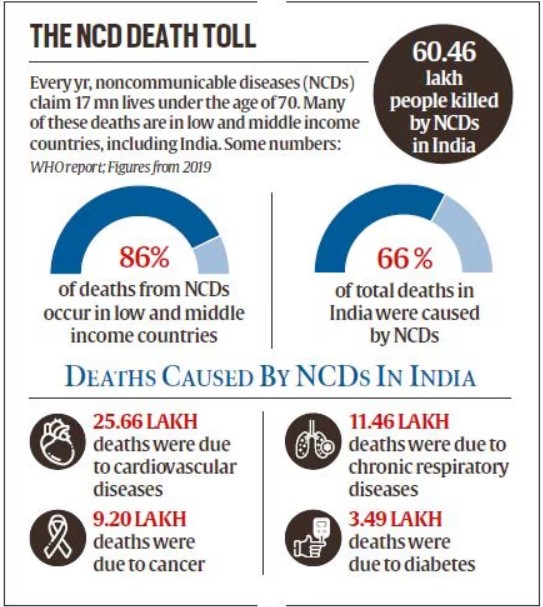
Non-Communicable Diseases (NCDs)

  • Definition: Chronic, non-infectious diseases not spread from person to person.
  • Major Types: Cardiovascular diseases (e.g., heart attacks, strokes), Cancers, Chronic respiratory diseases (e.g., asthma, COPD), Diabetes etc  
  • Risk Factors: Arise from a mix of genetic, physiological, environmental, and behavioral causes. 
  • Also Known As: Lifestyle diseases, when triggered by unhealthy habits. 

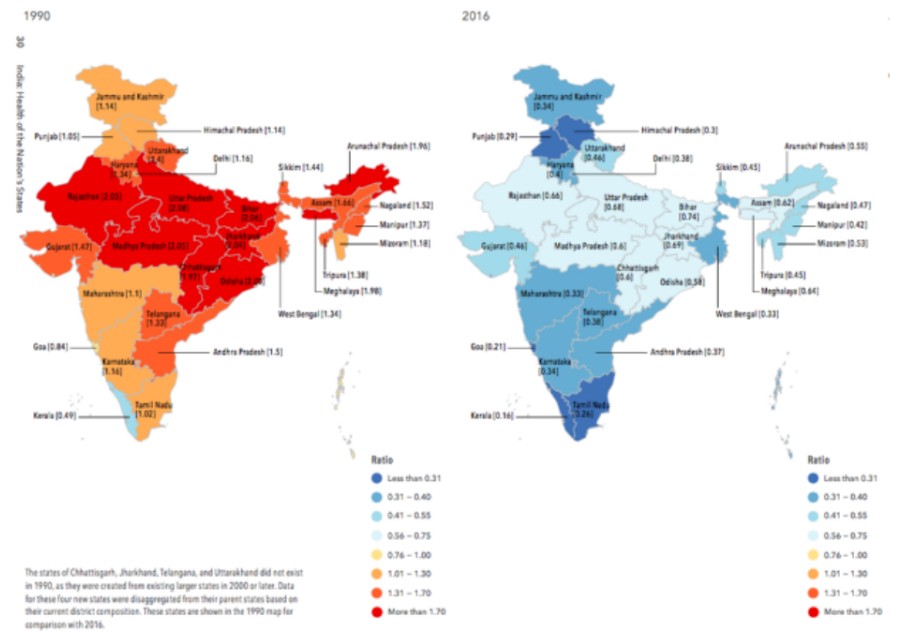
Epidemiological Transition Ratio Of Different States, 1990-2016

Challenges Highlighted 

  • Health Risks: Obesity linked to 13 types of cancers including breast, colorectal, pancreatic, liver, and kidney cancers.

Biological pathways

  • Hyperinsulinemia and insulin resistance promote cell growth and malignant transformation.
  • Chronic inflammation damages DNA and weakens immune surveillance.
  • Excess estrogen from fat tissue raises hormone-sensitive cancer risks.
  • Transgenerational Impact: Children raised in obese households normalize unhealthy eating and sedentary lifestyles, creating intergenerational cycles of risk.
  • Economic Consequences: Healthcare costs for obesity-related diseases pose a significant fiscal burden on India’s fragile health infrastructure.
  • Policy & Urban Challenges: Urban environments promote sedentary behaviour, easy access to ultraprocessed foods, and lack of physical infrastructure (e.g., walkable spaces). 

Way Forward

  • Household-Level Interventions: Treat obesity as a family-wide health issue. Promote home-cooked meals, physical activity, and nutrition literacy within families. 
  • Policy Reforms: Tax sugary drinks, implement front-of-pack labelling, and regulate marketing of ultraprocessed foods. Prioritise obesity prevention in cancer centres, not just treatment.  
  • Urban and Institutional Support: Make cities walkable and redesign spaces to encourage physical activity. Strengthen school- and workplace-based nutrition programmes to change food environments and social norms. 
  • Correct Misconceptions: Exercise alone isn’t enough; dietary correction is essential to reverse metabolic damage.


UPSC QEP 2026 Batch 5 - English
Buy now View Details
Submit Your Details to Learn More
I agree to give my consent to receive updates through SMS/Email & WhatsApp*.

NEEV GS + CSAT Foundation 2026/27
Buy now View Details


Join theIAShub’s Mains Answer Writing Program

Refine your answer writing skills and elevate your UPSC preparation with personalized support and expert feedback.

Fill out the form to get started with the program or any other enquiries !

I agree to give my consent to receive updates through SMS/Email & WhatsApp*.

Best IAS Coaching In Delhi, UPSC Online & Offline Classes by IAShub

Are you dreaming of becoming an IAS officer? Then, IAShub can be your best guide. It is one of the Best IAS Coaching in Delhi. Many students who want to clear the UPSC exam join IAShub for learning. The institute gives both online and offline classes. Their teachers are experienced and helpful. They easily explain every topic. Students also get notes, tests, and tips to do well in the exam.

UPSC Online Classes by IAShub

IAShub is in Delhi and is trusted by many UPSC students. It offers coaching for every part of the UPSC exam – Prelims, Mains, and Interview. The classes are simple and easy to understand. The teachers are experts and guide students in the right way. IAShub is also known for its helpful notes, test series, and answer-writing practice. IAShub is the best coaching in Delhi and also gives UPSC Online Classes. This helps students from any place in India to learn. The online classes are live and also recorded. So, students can watch them anytime. These classes cover the full UPSC syllabus.

Key Offerings Provided by IAShub

Here are some important services provided by IAShub:

  • UPSC Prelims: IAShub teaches for Prelims with a focus on basics. It also gives daily current affairs and monthly magazines.
  • Classroom Courses: IAShub has classroom learning for students in Delhi. The environment is good and peaceful for study.
  • Live Classes: Students who live far can join live UPSC online classes. These classes are just like real classes.
  • QEP for Mains: The Quality Enrichment Program (QEP) is special for Mains preparation. It helps students write better and faster.
  • Answer Writing: Regular answer writing practice is given. Teachers also check answers and give tips to improve.
  • Free Resource: IAShub gives free notes by toppers and helpful Main Booster material.
  • Test Series: Test series are available for every subject. These help students know their weak points and improve.
  • Interview Guidance Session: IAShub also gives interview practice sessions with experts. These help students feel confident.

UPSC Exam Overview

The UPSC Civil Services Exam has three parts:

  • Prelims: It has two papers: General Studies and CSAT.
  • Mains: It has nine papers, including essays and optional subjects.
  • Interview: It tests the personality and confidence of the student.

This exam is tough, but with the right guidance, it becomes easy to manage. Students must study smart and stay regular.

How IAShub Helps in the UPSC Journey

IAShub supports students from the beginning to the end. It gives the right books, tests, and notes. The classes are easy to follow, and the teachers are always ready to help. Students get personal doubt sessions too. The test series and answer checking help students learn where they need to do better. Also, free study materials save time and money.
IAShub also guides students during the final stage – the interview. Experts take mock interviews and give useful tips. This full support makes IAShub one of the best IAS coaching in Delhi.

Best IAS Coaching In Delhi FAQs

Yes, IAShub offers live and recorded online classes. Students can attend from any part of India.

Classes are available in both English and Hindi, so students can choose the language they are comfortable with.

The classroom centre is located in Delhi. Students can visit and join offline batches there.

IAShub gives interview guidance sessions to help students prepare for the final round of UPSC.