Daily Headlines : 18th March, 2024

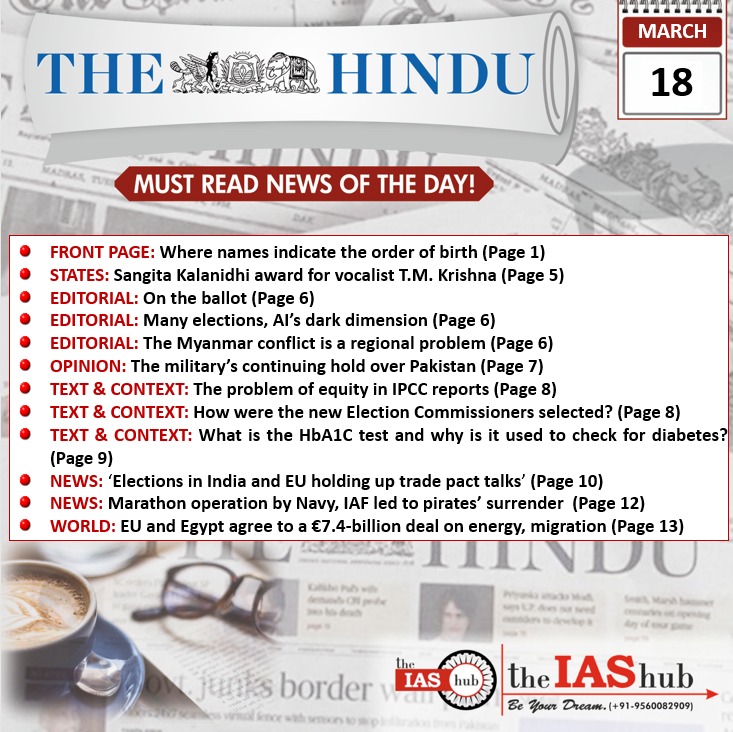
TH_Headlines_18 March
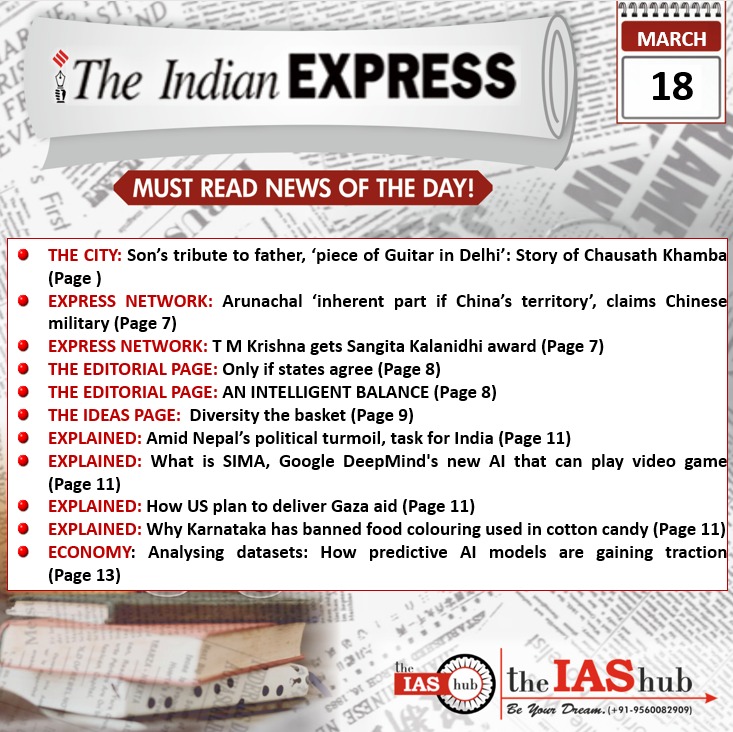
IE_Headlines_18 March

Context: India is estimated to have more than 10 crore people with diabetes, and another 13.5 crore people pre-diabetic, according to a nationwide study published in 2023.

Diabetes: Diabetes is a chronic, progressive non-communicable disease (NCD) characterized by high levels of blood sugar (blood glucose) in the body.

  • It occurs when:

oThe pancreas does not produce enough of the insulin hormone that regulates blood sugar.

oThe body cannot effectively use the insulin it produces.

  • Type 1 diabetes: It occurs when the pancreas fails to produce sufficient insulin. It is also called insulin-dependent diabetes.
  • Type 2 Diabetes: It is most common form of diabetes, accounting for 95% of diabetes cases in adults. With Type 2 diabetes, the pancreas usually produces some insulin. But either the amount produced is not enough for the body's needs, or the body's cells are not able to use the insulin so produced.
  • Implications: Diabetes disrupts the balance of insulin production or usage, leading to elevated blood sugar levels as glucose fails to enter cells effectively.

Hemoglobin A1C (HbA1c) Test

  • About: The HbA1C test provides insight into your average blood sugar levels over a span of two to three months.
  • Importance of Glucose: It derived from the foods we consume, serves as a vital energy source for our cells, facilitated by insulin.
  • Glucose-Hemoglobin Interaction: Glucose adheres to hemoglobin, a protein in red blood cells, proportionate to blood glucose levels, forming a basis for the A1C test.

    Non-Communicable Disease Burden in India

    • Prevalence of Hypertension and Obesity: Over 35% of Indians suffer from hypertension, while nearly 40% are affected by abdominal obesity, both contributing to the risk of diabetes.
    • India's Global Diabetes Contribution: India accounts for 17% of all diabetes patients worldwide, indicating a significant burden of the disease within the country.
    • Role of HbA1C Test: The haemoglobin A1C (HbA1C) test is widely used for diagnosing pre-diabetes and both type 1 and type 2 diabetes, as well as for managing the condition effectively.

Context: Google DeepMind recently revealed its latest AI gaming agent called SIMA, which stands for Scalable Instructable Multiworld Agent.


SIMA

  • About: It is an AI Agent distinct from models like OpenAI's ChatGPT or Google Gemini.
  • As an AI Agent:: Unlike AI models, SIMA can process data and take actions independently.
  • Versatility: SIMA serves as a generalist AI Agent, proficient in various tasks across virtual environments.
  • Virtual Assistant: Described as a virtual buddy, SIMA comprehends instructions and accomplishes tasks in diverse virtual settings.
  • Functionality: SIMA functions as a super-smart computer program, capable of understanding user needs and facilitating their realization in virtual realms.
  • Working:

oLanguage Comprehension: SIMA "understands" your commands due to its training in processing human language.

oLearning and Adaptation: SIMA learns and adapts through user interactions, becoming smarter over time.

oVersatility in Game Settings: SIMA can follow instructions in various game settings, surpassing typical AI capabilities.

oReal-World Application: Google DeepMind's research suggests translating advanced AI capabilities into practical actions through language interfaces, aiming to enhance the usefulness of AI agents like SIMA.


Training SIMA

  • Partnership with Game Developers: SIMA was trained in collaboration with game developers, marking a significant milestone in AI research.
  • Collaboration with Google Deepmind: Google Deepmind partnered with eight game studios to test SIMA on nine diverse video games, broadening its exposure.

Context: Recently, researchers published a study analyzing over 500 future emissions scenarios assessed by the UN Intergovernmental Panel on Climate Change (IPCC) in its latest reports.

IPCC Assessment Reports

  • About: IPCC assessment reports encompass three primary Working Group reports: physical science, climate adaptation, and mitigation action.
  • Synthesis Report: A synthesis report amalgamates insights from the three Working Group reports, offering a consolidated view of findings.
  • Thematic Special Reports: In addition to the primary reports, there are thematic special reports focusing on specific areas of climate change.
  • Scientific Evaluation: Each report rigorously evaluates climate-related scientific literature to present the current state of knowledge on climate change.
  • Seventh Assessment Cycle:The IPCC is presently conducting its Seventh Assessment cycle (AR7), continuing its vital role in informing global climate action.


Intergovernmental Panel on Climate Change (IPCC)

  • Creation: In 1988 by the World Meteorological Organization (WMO) and the United Nations Environment Programme (UNEP).
  • Objective: To provide governments at all levels with scientific information that they can use to develop climate policies.
  • Headquarter: Geneva, Switzerland.
  • Membership: It is an organization of governments that are members of the United Nations or WMO. The IPCC currently has 195 members.
  • Note: The IPCC does not conduct its own research. 
  • In 2007, IPCC was awarded with the Nobel peace prize.

Context: Recently, as visitors journey to the Nizamuddin dargah, a 14th-century shrine honoring Sufi saint Hazrat Nizamuddin Auliya, their gaze falls upon a remarkable sight to the right. This striking structure, known as Chausath Khamba or "64 pillars," captivates with its marble pillars and intricate lattice work, adding to the allure of the surroundings.

Chausath Khamba

  • About: constructed during 1623–24, stands as a testament to Mughal architectural brilliance in the heart of New Delhi's Nizamuddin precincts, dedicated to Sufi Muslim shrines and tombs.
  • Significance: The name "Chausath Khamba" translates to "64 pillars" in Urdu and Hindi, aptly describing the architectural feature that distinguishes this monument.
  • Builder and Purpose: Commissioned by Mirza Aziz Koka, son of Ataga Khan, during the reign of Mughal Emperor Jahangir, the structure served as a mausoleum for Mirza Aziz Koka himself.
  • Evolution of Structure: Originally designed as a hall, the monument underwent a transformation into a tomb, showcasing an innovative blend of eclectic architectural styles typical of the Mughal era.
  • Architectural Features: Constructed entirely of white marble, the square-shaped monument boasts 64 columns supporting twenty-five bays, each crowned with a dome, illustrating the grandeur of Mughal craftsmanship.


Hazrat Nizamuddin Auliya

  • Early Life: Sultan-ul-Mashaikh, Khwaja Syed Muhammad Nizamuddin Auliya, born in 1238, hailed from a lineage of esteemed Sufi scholars within the Chishti Order.
  • Spiritual Eminence: Hazrat Nizamuddin, also known as Mahbub-e-Ilahi, attained great spiritual heights, earning reverence as a Sufi saint.
  • Influence and Legacy: He holds a significant place in the annals of Indian spirituality, being one of the most renowned Sufis from the Indian Subcontinent.
  • Chishti Spiritual Lineage: Nizamuddin Auliya's spiritual lineage traces back to notable predecessors like Fariduddin Ganjshakar, Qutbuddin Bakhtiyar Kaki, and Moinuddin Chishti, who were pioneers of the Chishti Order in the Indian subcontinent.

Context: The Department of School Education and Literacy (DoSEL), Ministry of Education, Government of India, is set to conduct the Foundational Literacy and Numeracy Assessment Test (FLNAT) as part of the ULLAS - Nav Bharat Saaksharta Karyakram across 23 states.


Foundational Literacy and Numeracy Assessment Test (FLNAT)

  • About: The Department of School Education and Literacy (DoSEL), Ministry of Education, administers FLNAT under the ULLAS program in 23 states.
  • Target Audience: FLNAT is tailored to assess the foundational literacy and numeracy skills of non-literate learners who are registered for the program.
  • Components: FLNAT evaluates proficiency in Reading, Writing, and Numeracy across its three subjects.
  • Previous Instances: FLNAT has been conducted twice in 2023, in March and September, establishing a precedent for its administration.
  • Language Medium: The test is conducted in learners' regional languages, aligning with NEP 2020's emphasis on multilingualism and local language instruction.
  • Educational Impact Assessment: FLNAT plays a crucial role in evaluating the effectiveness of teaching-learning sessions conducted within the ULLAS program.
  • Certification Recognition: Successful candidates receive certificates from the National Institute of Open Schooling (NIOS), acknowledging their acquisition of foundational literacy and numeracy skills.

Nav Bharat Saaksharta Karyakram

  • About: It is a Centrally Sponsored Scheme approved by the Government of India for implementation during FYs 2022-27.
  • Alignment with National Education Policy: The scheme aligns with the recommendations of National Education Policy (NEP) 2020.
  • Target Population: It targets all non-literates of age 15 years and above in the country, focusing on females and educationally backward states.
  • Components:

oFoundational Literacy and Numeracy

oCritical Life Skills

oBasic Education

oVocational Skills

oContinuing Education.

  • Implementation Strategy: The scheme is to be implemented through volunteer teachers.


Context: India recently abstained in the UN General Assembly on a draft resolution led by Pakistan and co-sponsored by China on Islamophobia, advocating for recognition of "religiophobia" against Hinduism, Buddhism, Sikhism, and other faiths, emphasizing the importance of acknowledging all religions facing discrimination and violence.


UNGA Resolution

  • Resolution on Islamophobia: The 193-member General Assembly adopted the resolution 'Measures to combat Islamophobia', with a significant majority of 115 nations voting in favor, none against, and 44 abstentions.
  • India's Position on Religious Discrimination: India's Permanent Representative to the UN, Ambassador Ruchira Kamboj, condemned acts of discrimination based on religion, including anti-Semitism, Christianophobia, and Islamophobia.
  • Acknowledgment of Broader Scope: India emphasized the importance of acknowledging that phobias extend beyond Abrahamic religions, advocating for a broader understanding of religious discrimination.
  • Caution Against Precedent: India cautioned against establishing a precedent that could lead to numerous resolutions focusing on phobias tied to specific religions, expressing concern about the potential division of the United Nations into religious camps.


UN General Assembly 

  • Establishment: In 1945 under the United Nations (UN) Charter
  • Member Countries: All 193 members
  • UNGA President: The UNGA is headed by its President, who is elected for a term of one year.
  • Composition: United Nations General Assembly comprises all 193 Members of the United Nations.
  • Mandate: provides a unique forum for multilateral discussion of the full spectrum of international issues covered by the Charter.

Context: The near-13 year high services trade surplus in February has prompted economists to scale down their projections of India’s current account deficit (CAD) for the current financial year.


Current Account Deficit (CAD)

  • About: It is a measurement of a country’s trade where the value of the goods and services it imports exceeds the value of the products it exports.
  • Current Account Deficit Formula: Current Account Deficit = Total value of Imports – Total value of Exports
  • Current Account includes: Net income, such as interest and dividends, and transfers, such as foreign aid.
  • Current Account Represents: A country’s foreign transactions and, like the capital account, is a component of a country’s balance of payments (BOP).
  • Current Account Deficit Components: Trade Balance, Services Balance, Income Balance, and Transfers Balance.
  • Recent Status of India’s CAD: 1.0 per cent of GDP


Significance of Current Account Deficit

  • Indicator of Competitiveness: The current account deficit serves as a crucial indicator of a nation's competitiveness, reflecting the balance between imports and exports.
  • Economic Imbalance Indicator: A large current account deficit often signals economic imbalance, necessitating corrective measures like exchange rate depreciation or enhancing competitiveness over time.
  • Capital Inflows and Foreign Ownership: Financing the current account deficit entails attracting capital inflows, often through foreigners purchasing domestic assets, consequently leading to a greater foreign claim on assets and dividends.

Context: Indian Army contingent participate in the Tenth edition of Joint Military Exercise “LAMITIYE-2024” between the Indian Army and Seychelles Defence Forces (SDF).


Exercise “LAMITIYE-2024

  • About: Lamitiye, translating to "friendship" in Creole, is a training event held biennially in Seychelles since 2001.
  • Aim: To enhance interoperability in Sub-conventional Operations in Semi-Urban environment under Chapter VII of the United Nations Charter on Peace Keeping Operations.
  • Building Bilateral Military Relations: It seeks to build and promote bilateral military relations, exchanging skills, experiences, and good practices between both armies.
  • Joint Tactical Drills: Both sides will jointly train, plan, and execute a series of well-developed tactical drills for neutralizing likely threats in a Semi-Urban environment, while showcasing new-generation equipment and technology.
  • Developing Mutual Understanding: The exercise will contribute immensely to developing mutual understanding and magnifying jointness between the troops of both armies.

Seychelles

  • About: It officially the Republic of Seychelles, is an island country located in the Indian Ocean, known for its stunning archipelago and diverse culture.
  • Geographical Features

oArchipelagic State: Seychelles comprises 115 islands, as specified in its Constitution, offering a rich variety of landscapes and ecosystems.

oLocation: Situated approximately 1,500 kilometers (800 nautical miles) east of mainland Africa, Seychelles enjoys a strategic position in the Indian Ocean.

  • Capital: Victoria
  • Borders share with: Comoros, Madagascar, Mauritius, Mayotte, Réunion, Maldives, and the Chagos Archipelago.

Context: In a first, Southern California discovered a dog-killing flatworm parasite in the Colorado River as scientists warn of its spread in other states.


Heterobilharzia americana

  • About: It is a flatworm also called a liver fluke. It has now migrated to the west.
  • Found: Texas and other Gulf states
  • Cause: The worm responsible for canine schistosomiasis affects dogs' livers and intestines, posing a serious health risk.
  • Symptoms: Lack of appetite, vomiting, diarrhea, weight loss, and signs of liver damage.
  • Human Infection Risk: It does not typically infect humans, it can be transmitted.

Colorado River

  • About: It is one of the principal rivers (along with the Rio Grande) in the Southwestern United States and in northern Mexico. 

oIt originates in the Rocky Mountains of Colorado and flows through Utah, Arizona, Nevada, California, and Mexico before emptying into the Gulf of California in Mexico.


Context: New research in Physical Review Letters (PRL) has proposed a novel method to detect light dark matter candidates using laser interferometry to measure the oscillatory electric fields generated by these candidates.

Dark Matter

  • About: It is a hypothetical form of matter that is believed to exist in the universe but is invisible and does not interact with light. It makes up over 80% of all matter in the universe.
  • Dark Energy: Dark energy is an invisible force that works against gravity, thus, causing the universe to expand.

oOn the other hand, Dark matter exercises a gravitational pull on the universe, and more dark matter means universe will contract, and have a closed geometry, ending in a Big Crunch.

  • Universal Pressure: Dark energy is a form of energy that fills the entire universe and exerts a negative pressure, pushing galaxies and other matter away from each other.
  • Features: Unlike normal matter, dark matter does not interact with the electromagnetic force. This means it does not absorb, reflect or emit light, making it extremely hard to spot (It has not been discovered so far).
  • How do we know Dark Matter exists? - Dark Matter has mass, hence the gravitational pull. Thus, it can only be detected by its gravity effects. We can sense the dark matter present in the galaxy based on the distortion it causes (for e.g. bending of light etc.)
  • Importance of Dark Matter

oStructural Explanation: Dark matter is essential to explaining the observed structure of the universe.

oGalactic Distribution: It helps to account for the distribution of matter in galaxies and the cosmic web.

oUniversal Understanding: Understanding dark matter is important for developing a complete understanding of the universe and its evolution.


THEIASHUB
Get an Instant Call Back from Our Expert Mentors Now!
+91

UPSC QEP 2026 Batch 5 - English
Buy now View Details
Submit Your Details to Learn More
I agree to give my consent to receive updates through SMS/Email & WhatsApp*.

NEEV GS + CSAT Foundation 2026/27
Buy now View Details


Join theIAShub’s Mains Answer Writing Program

Refine your answer writing skills and elevate your UPSC preparation with personalized support and expert feedback.

Fill out the form to get started with the program or any other enquiries !

I agree to give my consent to receive updates through SMS/Email & WhatsApp*.

Best IAS Coaching In Delhi, UPSC Online & Offline Classes by IAShub

Are you dreaming of becoming an IAS officer? Then, IAShub can be your best guide. It is one of the Best IAS Coaching in Delhi. Many students who want to clear the UPSC exam join IAShub for learning. The institute gives both online and offline classes. Their teachers are experienced and helpful. They easily explain every topic. Students also get notes, tests, and tips to do well in the exam.

UPSC Online Classes by IAShub

IAShub is in Delhi and is trusted by many UPSC students. It offers coaching for every part of the UPSC exam – Prelims, Mains, and Interview. The classes are simple and easy to understand. The teachers are experts and guide students in the right way. IAShub is also known for its helpful notes, test series, and answer-writing practice. IAShub is the best coaching in Delhi and also gives UPSC Online Classes. This helps students from any place in India to learn. The online classes are live and also recorded. So, students can watch them anytime. These classes cover the full UPSC syllabus.

Key Offerings Provided by IAShub

Here are some important services provided by IAShub:

  • UPSC Prelims: IAShub teaches for Prelims with a focus on basics. It also gives daily current affairs and monthly magazines.
  • Classroom Courses: IAShub has classroom learning for students in Delhi. The environment is good and peaceful for study.
  • Live Classes: Students who live far can join live UPSC online classes. These classes are just like real classes.
  • QEP for Mains: The Quality Enrichment Program (QEP) is special for Mains preparation. It helps students write better and faster.
  • Answer Writing: Regular answer writing practice is given. Teachers also check answers and give tips to improve.
  • Free Resource: IAShub gives free notes by toppers and helpful Main Booster material.
  • Test Series: Test series are available for every subject. These help students know their weak points and improve.
  • Interview Guidance Session: IAShub also gives interview practice sessions with experts. These help students feel confident.

UPSC Exam Overview

The UPSC Civil Services Exam has three parts:

  • Prelims: It has two papers: General Studies and CSAT.
  • Mains: It has nine papers, including essays and optional subjects.
  • Interview: It tests the personality and confidence of the student.

This exam is tough, but with the right guidance, it becomes easy to manage. Students must study smart and stay regular.

How IAShub Helps in the UPSC Journey

IAShub supports students from the beginning to the end. It gives the right books, tests, and notes. The classes are easy to follow, and the teachers are always ready to help. Students get personal doubt sessions too. The test series and answer checking help students learn where they need to do better. Also, free study materials save time and money.
IAShub also guides students during the final stage – the interview. Experts take mock interviews and give useful tips. This full support makes IAShub one of the best IAS coaching in Delhi.

Best IAS Coaching In Delhi FAQs

Yes, IAShub offers live and recorded online classes. Students can attend from any part of India.

Classes are available in both English and Hindi, so students can choose the language they are comfortable with.

The classroom centre is located in Delhi. Students can visit and join offline batches there.

IAShub gives interview guidance sessions to help students prepare for the final round of UPSC.