Gini Index
Gini Index : Recently, the Indian government, in an official release, asserted that India is not only the world’s fourth-largest economy but also “one of the most equal societies today.”
o Citing the World Bank’s latest Poverty and Equity Brief, it highlighted that India’s Gini Index stands at 25.5, placing it as the fourth most equal country globally, behind the Slovak Republic, Slovenia, and Belarus.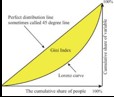
- About Gini Index : Also known as the Gini Coefficient or Gini Ratio is a widely used statistical measure to gauge income or wealth inequality within a country.
o Origin: It was developed in 1912 by Italian statistician Corrado Gini.
o Scale: The index ranges from 0 to 1 (or 0% to 100%), where:
- 0 indicates perfect equality (everyone has the same income or wealth).
_ 1 indicates perfect inequality (one person has all the income or wealth, and everyone else has none).
o Mathematical Basis: The Gini Index is derived from the Lorenz Curve, which:
- Plots population percentiles (horizontal axis) against cumulative income or wealth (vertical axis).
- Highlights the distribution gap between perfect equality and actual distribution.
o Interpretation: It reflects the degree of inequality, not the absolute level of income or wealth in a country.
o Data Concerns: In countries like India, the accuracy of the Gini Index can be affected by the source & type of data used, as regular surveys may not fully capture income & wealth data.
- About Lorenz Curve : A graphical representation that illustrates how income or wealth is distributed among different sections of a population. Its primary use is to demonstrate the level of inequality in the distribution of income or wealth within a society.

 Detailed Solutions & Explanations

