2 Minute Series_21 January 2026
21st January 2026
- Green Energy Corridor (GEC): Recently, the Government of India is planning Green Energy Corridor (GEC) Phases 3 and 4, a nationwide, next-generation transmission backbone to evacuate massive clean power additions and stabilise the national grid.
- About GEC: India’s flagship transmission programme for integrating renewable energy into the national grid.
- It is a critical enabler of India’s target of 500 GW non-fossil fuel capacity by 2030.
- Focus: Evacuation, balancing, and grid stability for solar and wind power.
- Phase 1: Targeted renewable evacuation: ~20 GW
- Coverage: 8 states including Gujarat, Rajasthan, Tamil Nadu, Karnataka
- Phase 2: Additional integration target: ~20 GW
- Expanded coverage including Kerala and Uttar Pradesh
- Phases 3 & 4: Planned evacuation capacity: ~150 GW of renewable energy
- Scale: 8–10 times larger than Phases 1 and 2 combined
- Coverage: Entire country, beyond traditional solar–wind hubs
- Strategic Importance: Enables large-scale renewable deployment beyond desert and coastal hubs. It Improves: Grid stability, Interstate power exchange and peak demand management
- Enhances credibility of India’s net-zero and energy security commitments
- Central Motor Vehicles (Second Amendment) Rules, 2026: Recently, the Government of India notified the Central Motor Vehicles (Second Amendment) Rules, 2026, strengthening enforcement of toll (user fee) payments on National Highways.
- Key Highlights: The move directly links pending toll dues with vehicle-related services, signaling a shift towards stricter, technology-driven compliance.
- Improve Electronic Toll Collection efficiency, prevent toll evasion, and ensure timely user fee payment on National Highways.
- “Unpaid user fee” now legally defined where ETC records vehicle passage but toll payment is not received under the National Highways Act, 1956.
- No Objection Certificate (NOC) for vehicle ownership transfer or inter-state transfer will not be issued if toll dues are pending.
- Renewal or issuance of Certificate of Fitness is barred until unpaid National Highway user fees are cleared.
- Commercial vehicles must have zero unpaid user fee to obtain or renew a National Permit.
- Amendments facilitate smoother user fee recovery under the upcoming Multi-Lane Free Flow (MLFF) barrier-less toll system.
- Vālmīkirāmāyaṇam: Recently, in a landmark cultural and scholarly development, a 233-year-old Sanskrit manuscript of the Vālmīkirāmāyaṇam has been permanently gifted to the International Ram Katha Museum, Ayodhya.
- About Vālmīkirāmāyaṇam: Accompanied by the Tattvadīpikā ṭīkā, preserving a classical exegetical tradition. Composed by Valmiki (Ādi Kavi), with commentary authored by Maheshvara Tirtha.
- Written in Sanskrit using the Devanāgarī script.
- Dated to Vikrama Saṁvat 1849, corresponding to 1792 CE.
- Represents a rare and carefully preserved textual lineage of the Ramayana
- The manuscript encompasses five major kāṇḍas: Bālakāṇḍa, Araṇyakāṇḍa, Kiṣkindhākāṇḍa, Sundarakāṇḍa, and Yuddhakāṇḍa.
- Integrates rich epic narration with deep philosophical interpretation, exemplifying the Itihāsa tradition.
- Objective: Develop Ayodhya as a global centre for Ramayana heritage
- Strengthens India’s manuscript preservation movement
- Aligns with India’s soft power diplomacy rooted in Itihāsa–Purāṇa traditions
- India–AI Impact Summit 2026: Recently, India is set to host the India–AI Impact Summit 2026 at Bharat Mandapam, marking the first time a Global South nation convenes a global AI summit.
- Key Highlights: Theme: “Welfare for All, Happiness of All”, aligning AI with inclusive development.
- Led by the Government of India with policy anchoring by MeitY under the IndiaAI Mission.
- Summit framework based on People, Planet, and Progress to guide responsible AI adoption.
- Seven Chakras of cooperation: Human Capital; Inclusion; Safe & Trusted AI; Resilience & Sustainability; Science; Democratizing AI Resources; AI for Economic Growth & Social Good.
- AI applications highlighted in justice delivery, smart cities, welfare schemes, and service efficiency.
- Sectoral AI use cases: Focus on healthcare, agriculture, education, finance, commerce, and rural economy.
- Strengthens multilateral cooperation and translates global AI principles into development outcomes.
- India AI Tinkerpreneur bootcamp for school students to foster early AI and entrepreneurship skills.
- Expected outcomes: Stronger AI governance, workforce transition, ecosystem partnerships, and responsible AI deployment.
- Strategic significance: Positions India as a global hub for development-oriented, inclusive, and trusted AI innovation.
- Bark Spiders: Recently, an international research team from China, Madagascar, Slovenia, and the United States studied bark spiders to identify the environmental and biological factors enabling production of exceptionally tough silk.

- Key Highlights: The study focused on Caerostris darwini and Caerostris kunthneri, expanding understanding of spider silk biomechanics.
- About Darwin’s Bark Spider: An extraordinary orb-weaving spider known for creating the largest and strongest webs ever recorded.
- It belongs to the Araneidae family, commonly called orb-weaver spiders.
- First discovered in 2001 and formally described in 2009.
- Native to Madagascar, where it inhabits riverine forests and wetland ecosystems.
- Physical Appearance: Females are medium-sized, measuring around 2–2.5 cm, while males are much smaller.
- Produces silk that surpasses steel and most synthetic fibres in both strength and toughness.
- Its silk is more than twice as tough as any other spider silk studied to date.
- Lifespan is relatively short, typical of orb-weaving spiders, with females generally outliving males.
- Ecological Importance: Plays a key role in regulating insect populations, contributing to the balance of freshwater and forest ecosystems.
- Anaemia: Recently, Indian states are shifting from oral pills to single-dose IV iron therapy for pregnant women to tackle persistently high anaemia more effectively.
- Key Highlights: Anaemia remains widespread in India, affecting 1% of children, 57% of women, and 52.2% of pregnant women (NFHS 2019–21).
- In pregnancy, anaemia increases the risk of pre-term delivery, low birth weight, and maternal complications.
- Oral iron therapy often fails due to poor compliance caused by gastrointestinal side effects and slow haemoglobin response.
- Late detection and irregular intake result in many women not reaching safe haemoglobin levels before delivery.
- Intravenous iron existed earlier under Anaemia Mukt Bharat but required multiple infusions and hospital visits.
- Ferric Carboxymaltose (FCM) has transformed care by enabling a single-dose IV infusion.
- Single-dose FCM ensures rapid haemoglobin correction, especially critical in late pregnancy.
- IV iron is recommended for severe anaemia (Hb 5–6.9 g/dL in pregnancy; 5–7.9 g/dL in lactation).
- IV iron is also indicated in moderate anaemia when oral iron is not tolerated or ineffective.
- Single-dose IV FCM offers a reliable, time-efficient, and outcome-oriented solution for maternal anaemia management.
- Indiaphonte Bijoyi: Recently, scientists formally identified a previously unknown microscopic crustacean as a new genus and species, named Indiaphonte bijoyi.
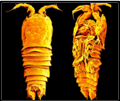
- About Indiaphonte bijoyi: It is a copepod belonging to the family Laophontidae under the order Harpacticoida, a group adapted to life within marine sediments.
- The species is part of meiofauna, minute aquatic invertebrates measuring less than 1 mm and observable only under a microscope.
- Found in the Kavaratti lagoon, a shallow, coral-rich lagoon known for high marine biodiversity.
- The genus name Indiaphonte reflects India’s contribution to marine taxonomy, while bijoyi honours noted marine scientist Bijoy Nandan.
- Researchers identified a unique combination of morphological features not seen in any previously known genus within Laophontidae.
- Physical features: Measures approximately 518–772 micrometres, with females slightly larger than males; body is semi-cylindrical, flattened top-to-bottom, widest at mid-section, and tapering towards the rear.
- Adaptive anatomy: Possesses antenna-like sensory structures and specialised limbs suited for movement and survival within sediment environments.
- While crustaceans include large forms like crabs, lobsters, prawns, krill, and barnacles, microscopic groups include copepods, cladocerans, ostracods, and amphipods.
- Meiofaunal copepods play a critical role in nutrient recycling, grazing on microalgae, and supporting aquatic food webs.
- Mandatory Labelling of AI-Generated Content: Recently, the Government of India is set to finalise rules requiring mandatory labelling of AI-generated and synthetic content.
- Key Highlights: Ensure AI-generated or synthetic content is clearly distinguishable from factual, human-created information.
- The rules will apply to AI tool providers (e.g., ChatGPT, Grok, Gemini) and major social media platforms.
- Labelling allows users to critically assess content and prevents AI outputs from masquerading as truth. Large tech firms and platforms are considered technically capable of implementing clear AI labelling.
- Draft regulations are in the final stages and currently undergoing legal scrutiny.
- Draft rules mandate labelling, traceability, accountability, and metadata embedding for AI-generated or modified content.
- Visibility requirement: Labels must cover at least 10% of visual content or the first 10% of an audio clip.
- Pax Silica Summit: Recently, the United States convened the first Pax Silica Summit, signalling a strategic push to secure rare earth elements (REEs), semiconductors, and AI supply chains amid rising geopolitical competition.
- About Pax Silica: Pax (peace) + Silica (core material for semiconductors) symbolises peace through secure technology supply chains.
- The initiative aims to: Reduce coercive economic dependencies
- Secure global tech and AI supply chains
- Build trusted digital and manufacturing infrastructure
- India’s Strategic Relevance to Pax Silica: India contributes robust digital public infrastructure, rapid enterprise-level AI adoption, a vast technology workforce, and a long-standing India–U.S. collaboration ecosystem.
- Strong policy momentum is visible through the National AI and Semiconductor Missions, backed by large public funding, domestic investments (e.g., Tatas), global players like Micron, and a growing AI start-up base.
- Pax Silica enables India to scale partnerships with Japan, Singapore, Israel and others, accelerating semiconductor fabs and AI ecosystem development.
- Participation reduces India’s vulnerability to unilateral export controls and supply-chain coercion in critical technologies.

 Detailed Solutions & Explanations

