2 Minute Series_13th OCTOBER 2025
13th October 2025
- Iron Age culture: Recently, the Tamil Nadu State Department of Archaeology (TNSDA) uncovered compelling evidence of an Iron Age culture at Thirumalapuram in Tenkasi district, comparable to the renowned sites of Adichanallur and Sivagalai.
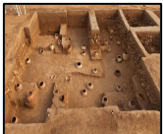
- Key Highlights: Location: Situated 10 km northwest of Thirumalapuram village, between two seasonal streams originating from the Western Ghats near Kulasegarapereri tank.
- Estimated Period: Tentatively dated to the early to mid-third millennium BCE.
- Excavation Details: Discovery of a rectangular stone slab chamber with urn burials and urns, the first-of-its-kind in Tamil Nadu. The chamber, made of 35 stone slabs, was filled with cobblestones up to 1.5 metres deep.
- Artefacts Unearthed: Ceramics: Rich collection from graves and grave goods including:
- White-painted black-and-red ware
- Red ware, red-slipped ware, black-polished ware, and coarse red ware - Symbolic Discoveries: Urn symbols considered among the most striking finds. One red-slipped pot depicted dotted designs of a human figure, mountain, deer, and tortoise.
- Antiquities Found (78 in total): Items made of bone, gold, bronze, and iron — including tweezer, sword, spearhead, gold ring, axe, dagger, chisel, bonehead, and arrowhead.
- Connectivity and Innovation Centre (CIC): Recently, India and the United Kingdom jointly launched the India–UK Connectivity and Innovation Centre (CIC).
- About the CIC: Designed to advance digital inclusion and develop secure, innovative, and resilient communication systems.
- It will operate under the UK–India Technology Security Initiative, jointly implemented by the UK Research and Innovation (UKRI) and India’s Department of Telecommunications (DoT).
- The Centre aims to integrate both nations’ research and industry expertise, connecting academic research, lab testing, field trials, and market deployment in advanced connectivity technologies.
- Key Focus Areas (2025–2029): AI in Telecom: Enhance network efficiency, optimise operations, and enable new digital services.
- Non-Terrestrial Networks (NTNs): Develop satellite and airborne systems for high-speed rural connectivity.
- Telecom Cybersecurity: Strengthen network resilience with secure and interoperable communication systems.
- Project Waterworth: Recently, Meta Platforms chose Mumbai and Visakhapatnam as the landing sites in India for its multibillion-dollar undersea cable project, Waterworth.
- About Project Waterworth: A flagship subsea cable initiative by Meta Platforms, designed to enhance global data connectivity and support the growing demand for digital infrastructure.
- Connectivity: Links the United States, India, Brazil, and South Africa, forming the world’s longest subsea cable — stretching over 50,000 km.
- Route Design: Built in a W-shaped configuration, the route strategically bypasses the Red Sea corridor to minimize geopolitical and cable damage risks.
- Timeline & Capacity: Expected to become operational by 2030, with an impressive design capacity of 1 petabit per second (Pbps).
- Strategic Importance: Strengthens India’s position as a major hub in the global AI and data infrastructure network.
- Supports data localisation initiatives and enhances the country’s digital ecosystem.
- Boosts connectivity resilience across continents, enabling faster and more secure data transfer.
- Green Sea Turtle: Recently, the International Union for Conservation of Nature (IUCN) upgraded the Green Sea Turtle’s Red List status from Endangered to Least Concern, highlighting the success of long-term global conservation efforts.
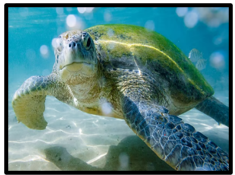
- About Green Sea Turtle: The largest hard-shelled sea turtle in the world.
- Its name refers to the green-colored fat beneath the shell (carapace), not the shell’s color, which varies from olive to black.
- Diet: Changes with age — juveniles are carnivorous, while adults become omnivorous.
- Acts as a keystone species in tropical marine ecosystems, maintaining healthy seagrass beds and coral reefs.
- Distribution: Found across tropical and subtropical waters worldwide.
- Distinct Features: Possesses a small head compared to other sea turtles.
- No visible ears — their eardrums are covered by skin; they hear best at low frequencies and have an excellent sense of smell.
- Lifespan: Estimated at 60–70 years. - Conservation Status: IUCN Red List: Least Concern (improved from Endangered).
- QR code-based Kiosk: Recently, Gurugram became India’s first city to launch a QR code-based kiosk for seamless traffic challan payments, marking a major step toward digital governance and smart city infrastructure.
- Key Highlights: A joint initiative of the Gurugram Police and the Gurugram Metropolitan Development Authority (GMDA).
- CSR Initiative: Set up under a Corporate Social Responsibility (CSR)
- Functionality: Drivers can check and pay pending challans by entering their vehicle number and scanning a QR code.
- Challans pending in court or overdue by more than 90 days cannot be paid through the kiosk. - Objective: To make challan payment faster and simpler, easing the workload of traffic police while enhancing citizen convenience through digital tools.
- Emergency Call Feature: A trial run of video-based emergency call points was conducted earlier.
- These will be linked to Dial 112 and the Police Commissioner’s Control Room, operating 24×7. Each unit will have beacon lights for visibility and allow citizens to connect via video call for emergencies or help requests.
- Natural Farming: Recently, farmers in Himachal Pradesh have increasingly embraced natural, chemical-free farming practices, backed by State policies that promote sustainable agriculture and farmer welfare.
- Flagship Scheme: Implemented under Prakritik Kheti Khushhal Kisan Yojana (PK3Y), launched seven years ago.
- Aims to promote non-chemical, natural farming across the State.
- 06 lakh farmers trained, with 2.22 lakh farmers practising natural farming partially or fully across 38,437 hectares.
- Over 2 lakh farmers certified under CETARA–NF (Certified Evaluation Tool for Agriculture Resource Analysis), a self-assessment certification system for natural farmers.
- Government Support and MSP: Minimum Support Prices (MSPs) introduced under PK3Y for naturally grown crops: Maize: ₹40/kg, Wheat: ₹60/kg, Raw turmeric: ₹90/kg and Barley (Pangi tribal belt, Chamba): ₹60/kg
- Himachal Pradesh offers the highest MSPs in India for naturally grown crops.
- Strengthens market confidence and encourages wider adoption of natural farming.
- Sugamya Bharat App: Recently, the Ministry of Social Justice and Empowerment launched the revamped “Sugamya Bharat App” during the Purple Fest in Goa.
- About Sugamya Bharat App: Launched under: Accessible India Campaign (Sugamya Bharat Abhiyan)
- Implementing Agency: Department of Empowerment of Persons with Disabilities (DEPwD), under the Ministry of Social Justice and Empowerment.
- Purpose: A citizen-led digital platform designed to make India’s public spaces more inclusive for divyangjan (persons with disabilities) and senior citizens.
- Nature: A flagship initiative aimed at advancing accessibility and promoting participation through technology.
- Key Features: Offers a single platform for accessing government schemes, scholarships, benefits, and employment opportunities, simplifying navigation for users.
- Lists opportunities from both government and private sectors, customized for persons with disabilities.
- Available in 10 Indian languages.
- Allows users to register complaints about inaccessible infrastructure or services, ensuring public accountability.
- Provides real-time assistance and improved user experience.
- SPARK–4.0: Recently, the Central Council for Research in Ayurvedic Sciences (CCRAS) under the Ministry of Ayush launched SPARK–4.0 (Studentship Program for Ayurveda Research Ken) for the year 2025–26.
- Key Highlights: It is the fourth edition of CCRAS’s flagship program designed to promote research orientation among BAMS undergraduates.
- Implementing Body: Central Council for Research in Ayurvedic Sciences (CCRAS), Ministry of Ayush, and Government of India.
- Objective: To foster scientific curiosity and a research-driven mindset among young Ayurveda scholars, integrating classical Ayurvedic wisdom with modern scientific approaches.
- Main Features: 300 BAMS students will receive ₹50,000 studentships (₹25,000 per month for two months).
- Open to students from NCISM-recognized Ayurveda colleges across India.
- Participants undertake short-term, faculty-guided independent research projects.
- Successful candidates are awarded a certificate upon completion. - Significance: Prepares a pipeline of trained researchers, promoting innovation and the integration of traditional medicine into public health systems.
- Araneus Nox Spider: Recently, a survey conducted in the Idukki Wildlife Sanctuary recorded the Araneus nox spider species in India for the first time.

- About Araneus nox: An orb-weaving spider belonging to the family Araneidae.
- Commonly known as the Leathery Garden Orb-weaver.
- It was first described in 1877 by French arachnologist Eugène Simon from Basilan, Philippines.
- The species is known for spinning near-perfect, vertically oriented circular webs on vegetation and tree branches.
- Habitat: Commonly found in gardens, forests, and backyards.
- Distribution: Widely distributed across Southeast Asia, including Cambodia, Laos, Myanmar, Thailand, Vietnam, the Philippines, Malaysia, and Indonesia.
- Appearance: Its coloration ranges from light brown to jet black, sometimes showing clusters of light brown setae on the sides of the abdomen. It has a distinctively textured, leathery abdomen, characteristic of small to medium-sized orb-weavers.
- Diethylene Glycol (DEG): Recently, Madhya Pradesh witnessed a heartbreaking tragedy as at least 14 children died after consuming Coldrif syrup, later found to be contaminated with the deadly chemical diethylene glycol (DEG).
- About DEG: Chemical Name: 2,2-oxydiethanol / diglycol (Formula: C₄H₁₀O₃)
- Appearance: Clear, colourless, and odourless liquid.
- Properties: Soluble in both water and many organic compounds; hygroscopic (absorbs moisture).
- Industrial Uses: Commonly used in antifreeze, brake fluids, and solvents — it has no safe application in human consumption.
- Toxicity: When ingested, DEG is metabolized into toxic compounds that cause severe kidney damage, leading to acute kidney injury, anuria (inability to urinate), and often death.
- Symptoms of Poisoning: Nausea, vomiting, abdominal pain, and lethargy, which can quickly progress to renal failure.

 Detailed Solutions & Explanations

