2 Minute Series_11th December 2025
11th December 2025
- India Skills Report 2026: Recently, the India Skills Report 2026 was released, offering an in-depth assessment of the nation’s employability landscape based on 100,000+ candidate evaluations from the Global Employability Test (G.E.T.).
- About India Skills Report: The report has been released annually since its first edition in 2014.
- Jointly prepared by the Educational Testing Service (ETS) along with CII, AICTE, and the Association of Indian Universities (AIU).
- Objective: To evaluate India’s employability trends, identify skill gaps, and support policymaking, industry strategies, and institutional workforce planning.
- Theme for 2026: Focuses on gig work, freelancing, AI-enabled roles, remote work, and entrepreneurship.
- Key Findings: National employability improved from 2% (2022) to 54.81% (2025) and further to 56.3% (2026).
- India accounts for 16% of the global AI workforce, projected to reach 25 million experts by 2027.
- More than 90% of employees now use generative AI tools, showing strong digital penetration across workplaces.
- India’s gig and freelance workforce is expected to grow to 5 million by 2030, with project-based hiring rising 38% annually.
- Most Employable States (2026): Uttar Pradesh, Maharashtra, and Karnataka.
- Deepavali: Recently, Deepavali, India’s festival of lights, was officially inscribed on UNESCO’s Representative List of the Intangible Cultural Heritage of Humanity.
- Key Highlights: Announcement made during the 20th session of UNESCO’s Intergovernmental Committee at the Red Fort, New Delhi.
- UNESCO recognises Deepavali as living heritage that: Strengthens social bonds-
- Supports traditional craftsmanship
- Reinforces generosity, well-being, and cultural values
- Contributes to Sustainable Development Goals (livelihoods, gender equality, cultural education, community welfare) - Role of the Indian Diaspora: Southeast Asia, Africa, Gulf countries, Europe and The Caribbean
- Diaspora celebrations have strengthened cultural bridges worldwide.
- Tangail Saree: Recently, at the 20th Session of the UNESCO Intergovernmental Committee for the Safeguarding of Intangible Cultural Heritage, Bangladesh secured international recognition for the Tangail saree weaving tradition.
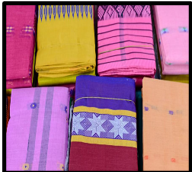
- About Tangail saree: Originates from the Tangail district of Bangladesh.
- It is handwoven using cotton or silk, often adorned with delicate floral and geometric motifs.
- Known for being lightweight, the saree is valued for its soft texture, elegant borders, and vibrant colours.
- Cultural Importance: The Tangail saree holds a special place in Bengali cultural identity.
- It is traditionally worn during festivals, weddings, and major celebrations, symbolising artistry, heritage, and community pride. - Significance of the UNESCO Recognition: The inscription marks the fulfilment of a long-standing national aspiration for Bangladesh.
- It brings global recognition to Tangail’s weaving communities, who have preserved and refined this craft over more than two centuries.
- The honour is expected to elevate international awareness, support preservation efforts, and strengthen artisan livelihoods.
- In 2024, India granted a Geographical Indication (GI) tag to the “Tangail Saree of Bengal”.
- Global Environment Outlook-7 (GEO-7): Recently, the United Nations Environment Programme’s (UNEP) Global Environment Outlook-7 (GEO-7) reported nine million annual deaths, with over 90% occurring in low- and middle-income countries.
- Key Findings: Air pollution contributes to nine million deaths every year, mostly in low- and middle-income countries. Pollution and climate change are creating a “vicious cycle”, intensifying health and ecological damage.
- Wildfires have become more frequent and intense due to high temperatures and prolonged droughts.
- Global temperature in 2024 rose to 55°C above pre-industrial levels, further destabilizing atmospheric chemistry.
- Global atmospheric concentrations of major GHGs—CO₂, methane (CH₄), nitrous oxide—continue to rise.
- SO₂ and NO₂ levels decreased in Europe and North America but increased across parts of Asia.
- 5 levels improved in parts of North America, Europe, Sub-Saharan Africa, Southeast Asia.
- Major megacities like Delhi, Tehran, and Lagos continue to record dangerously high pollution.
- Nanoparticles from fossil fuels, transport, and industry pose rising health risks yet remain poorly monitored. Microplastics increasingly affect regional and transboundary air quality.
- Pollution is now linked not only to respiratory and heart diseases but also to cognitive decline, dementia, and type-2 diabetes, including among children.
- Climate-Driven Mass Extinction: Recently, a study in Global Change Biology warned that climate-driven extreme heat and rapid land-use change could push nearly 8,000 vertebrate species toward extinction by century’s end.
- Key Findings: The study assessed 30,000 vertebrate species to determine how extreme heat and land conversion will reshape their future ranges.
- By 2100, around 7,895 species may become globally threatened as they are exposed to extreme heat events and land use changes across their entire geographic range.
- Amphibians and reptiles are projected to be far more exposed to unsuitable conditions than birds and mammals under every future scenario.
- Even in the most optimistic scenario, amphibians may lose 23% and reptiles 13% of their 2015 suitable ranges.
- Birds and mammals fare comparatively better, with only 2% and 4% loss under similar conditions.
- Species with smaller range sizes, especially amphibians and reptiles, face significantly higher extinction pressure.
- The synergistic impact of climate change and land use is expected to hit several regions particularly hard: Sahel Region: Sudan, Chad, Mali
- Middle East: Afghanistan, Iraq, Saudi Arabia
- South America: Brazil, Bolivia, Paraguay
- South Asia: India and Australia: Western Australia
- Goniopora Coral Colonies: Recently, a catastrophic combination of extreme ocean heat and a rare coral disease black band disease (BBD) wiped out nearly 75% of Goniopora coral colonies at One Tree Reef on the Great Barrier Reef.
- Key Findings: Mortality occurred during the fourth global mass bleaching event, affecting 84% of reefs worldwide.
- Goniopora corals are normally thermally tolerant, making the collapse especially alarming.
- Bleaching Followed by Rare Disease Outbreak: Severe bleaching weakened corals, enabling rapid and unprecedented spread of BBD.
- BBD, historically rare in the southern Great Barrier Reef, spread epizootically, infecting 61% of bleached colonies within months.
- Disease affected only bleached corals; other genera that bleached in 2024 did not develop BBD.
- Surveys of 700+ colonies confirmed widespread bleaching, rapid disease progression, and high mortality.
- Hydrogen-Powered Train: Recently, India achieved a major technological milestone by completing its first indigenous hydrogen-powered train-set, marking a significant step toward cleaner, alternative-fuel mobility in the railway sector.
- Key Highlights: Represents a major milestone in clean-energy transition for national rail transport.
- A hydrogen production plant is being established at Jind.
- Hydrogen will be produced using the electrolysis process, the key method for generating green hydrogen.
- Plant will supply hydrogen fuel specifically for the new train-set.
- The indigenously designed system is currently the world’s longest hydrogen train-set on broad gauge with 10 coaches. At 2400 kW, it is also the most powerful hydrogen train-set globally in its category.
- Fully designed and developed in India, showcasing railway sector innovation and engineering leadership.
- Reinforces the nation’s commitment to self-reliance in advanced mobility technologies.
- Environmental Benefits: Zero CO₂ emissions — the only emission is water vapour.
- AviSpray-10c: Recently, AvironiX Drones, a Chennai-based deep-tech company specialising in precision agriculture and defence technology, announced the launch of its latest innovation, the AviSpray-10c.
- About the AviSpray-10c: A backpack-sized agricultural spraying drone, making it 53% smaller than most current-generation models.
- The device aims to reduce the cost, operational complexity, and manpower required for drone-based crop spraying.
- Unlike many agri-drones tested mainly in controlled settings, the AviSpray-10c has undergone extensive real-world validation.
- The drone is built using insights from over 6,000 acres of actual spraying operations across crops like sugarcane and paddy, ensuring practical field-readiness.
- Key Advantages: Backpack-sized design enables easy transport on scooters and bicycles.
- Removes the need for large transport vehicles or permanent drone mounting boxes.
- Allows single-operator deployment without requiring any support staff.
- Capable of covering up to 5 acres per battery charge, about 60% more than many comparable platforms.
- Requires fewer batteries, lowering upfront costs and fuel consumption.
- Delivers 2× better spraying accuracy than conventional models.
- Equipped with terrain-following radar, collision-avoidance technology, and multiple nozzle options.
- Features swappable chemical tanks for faster turnaround during operations.
- Sudden Stratospheric Warming (SSW): Recently, meteorologists warned that a Sudden Stratospheric Warming (SSW) may occur in December 2025, which could disrupt winter weather across the Northern Hemisphere.
- About SSW: Refers to a rapid temperature increase — sometimes up to 50°C within a few days, in the stratosphere, the atmospheric layer above the troposphere.
- The event is triggered when Rossby waves rise from the troposphere and dissipate in the stratosphere, transferring energy and momentum
- This process weakens the polar vortex, a strong ring of westerly winds that normally keeps cold Arctic air confined near the poles.
- How SSW Disrupts the Atmosphere: When Rossby waves disrupt the polar vortex, the circulation slows and the air mass stops spinning effectively.
- As the spinning weakens, the air compresses and heats up, causing a dramatic rise in stratospheric temperatures.
- The warmed air then propagates downward, disturbing the jet stream — the high-altitude wind band that shapes weather patterns.
- A distorted jet stream allows cold Arctic air to spill southward into the mid-latitudes.
 Detailed Solutions & Explanations

