2 Minute Series_16 September 2025
16th September 2025
- Eco-Friendly Battery: Recently, Indian researchers developed a foldable, touch-safe, and eco-friendly battery that overcomes the overheating and explosion risks of conventional lithium-ion batteries.
- Key Highlights: Unlike lithium-ion batteries (prone to overheating and explosion), this battery is safe to touch and foldable like paper.
- Key materials used: Aluminum (abundant, cost-effective, eco-friendly)
- Water-based electrolyte (safer, sustainable)
- Cathode: Copper hexacyanoferrate (CuHCFe) with pre-filled aluminum ions
- Anode: Molybdenum trioxide (MoO₃)
- Performance: Retains 77% capacity after 150 charge–discharge cycles
- Highly flexible – works even when bent or folded completely in half
- Demonstrated by powering an LCD display under extreme bending
- Benefits: Safer (no explosion risk)
- Cheaper (aluminum-based, abundant materials)
- Eco-friendly (less environmental hazard compared to lithium-ion)
- Durable and reliable for long-term daily use
- Annual Report on Registration of Births and Deaths: Recently, the national capital witnessed a decline in both the sex ratio at birth and the birth rate in 2024, according to the Annual Report on Registration of Births and Deaths.
- Key Highlights: Sex ratio at birth in Delhi fell from 922 females per 1,000 males in 2023 to 920 in 2024 (933 in 2020).
- A 1% dip in sex ratio at birth equals nearly 1,800 fewer females, according to experts.
- Birth rate declined to 14 per 1,000 population in 2024, down from 66 in 2023.
- Death rate increased to 37 per 1,000 population in 2024, up from 6.16 in 2023.
- Out of total births, 09% (2,94,464) were institutional and 3.91% (11,995) were domiciliary.
- Mother’s age at delivery: 25–29 years: 36.98% (highest)
- 20–24 years: 27.11%
- 30–34 years: 24.57%
- 19 years or less: 2.57%
- International Electrotechnical Commission: Recently, India inaugurated the 89th International Electrotechnical Commission (IEC) General Meeting in New Delhi, marking a milestone in global standardisation efforts.
- Key Highlights: India becomes the 13th country to issue the OIML(International Organization of Legal Metrology) pattern approval certificate, a milestone in legal metrology.
- Inflation at lowest in 11 years, monitored through 474 price monitoring centres
- Upcoming project to disseminate precise Indian Standard Time in collaboration with NPL and ISRO, from 5 sites across India.
- Bureau of Indian Standards (BIS) achievements: Nearly 24,000 standards
- Certification coverage expanded from 106 products (2014) to 769 products under 186 QCOs (2025).
- HUID-based hallmarking (gold) since 2021: Over 48 crore articles hallmarked, centres increased from 285 (2014) to 1,600 (2025).
- Silver jewellery hallmarking also introduced.
- Laboratory network expanded from 81 labs (2014–15) to 382 (2025); empanelled labs from 62 to 287.
- Outreach in 600+ districts to spread awareness of quality standards. - India’s manufacturing sector adopting Industry 4.0, automation, cyber-physical systems.
- Garra Nambashiensis: Recently, researchers identified a new species of freshwater fish, named Garra nambashiensis, in Manipur.
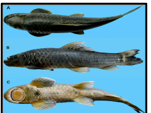
- About Garra nambashiensis: Taxonomy: Belongs to the Labeonine family.
- Location of discovery: Found in Taretlok, a tributary of the Chindwin River, near Nambashi Valley in Manipur’s Kamjong district.
- Habitat: Collected from swift-flowing riffles with algae-covered gravel beds and a mixed substrate of cobbles, boulders, pebbles, sand, fine silt, and coarse sediments.
- Distinct features: Quadrate-shaped proboscis
- 7–8 acanthoid tubercles on the anterolateral margin
- Black spots on the opercle
- 8–11 dorsal-fin scales
- Six black stripes running up to the hypural plate - Size: Typically measures 9–14 cm (90–140 mm). Locally known as Nutungnu.
- Diversity of Garra in Northeast: Around 60 species recorded from the Eastern Himalayan and Indo-Burma regions.
- Global Plastic Outlook: Recently, the OECD’s ‘Global Plastic Outlook’ reported that plastic pollution is reaching alarming levels, with waste projected to triple by 2060 to 1.2 billion tonnes, posing a grave ecological threat.
- Key Findings: Global plastic production doubled between 2000 and 2019, reaching 460 million tonnes, largely driven by packaging and fast consumption.
- Poor Recycling: Only 9% of plastic waste is recycled, with the rest ending up in landfills, rivers, and open dumps.
- Ocean Pollution: Around 11 million tonnes of plastic enter the oceans every year, endangering marine life and contaminating the food chain.
- Microplastic Spread: Plastics break down into micro and nano particles, now found in air, water, soil, and even human blood and lungs.
- Future Outlook: OECD warns that by 2060, global plastic waste could nearly triple to 1.2 billion tonnes, overwhelming waste management systems.
- Eustoma: Recently, Exotic Eustoma bloomed for the first time in Odisha in a polyhouse at Sanatanpali, Sambalpur district, developed by CSIR–NBRI. The National Botanical Research Institute (NBRI) is a research arm of the Council of Scientific and Industrial Research (CSIR).

- About Eustoma (Lisianthus / Prairie Gentian): A herbaceous annual flower from the gentian family, also known as Lisianthus or Prairie Gentian.
- Valued worldwide as a premium ornamental flower for its vibrant colors and long vase life.
- Native to Mexico, the southern United States, the Caribbean, and northern South America.
- Typically found in grasslands and disturbed habitats, thriving in warm climates.
- Key Features: Large, funnel-shaped blooms in shades of pink, purple, white, and blue, popular in global floriculture.
- Grows 30–90 cm tall
- Diversity: Available in single, double, and rare bicolored varieties, widely used for weddings, décor, and exports.
- Manki-Munda System: Recently, Ho tribals in Jharkhand’s Kolhan region protested against alleged interference in their traditional Manki-Munda self-governance system following the removal of some Mundas.
- About Manki-Munda System: A traditional, decentralised self-governance system practiced by the Ho community in Jharkhand’s Kolhan region.
- Based on a hierarchy of village heads (Mundas) and pidh heads (Mankis) who jointly handle dispute resolution and community affairs.
- Origin & Historical Background: Pre-British Era: Entirely community-driven, with no taxation or outside authority.
- Mankis and Mundas became intermediaries between the colonial state and the tribe, ensuring local autonomy while linking Kolhan to British India.
- How the System Functions:
- Munda: Village-level head, resolves disputes and manages local order.
- Manki: Leader of a pidh (cluster of 8–15 villages), acts as an appellate authority if Munda-level mediation fails.
- Decisions are based on customary laws, not statutory legislation, and the framework continues post-Independence.
- International Seabed Authority: Recently, India received a licence from the International Seabed Authority to explore polymetallic sulphides in the Indian Ocean.
- India’s New Exploration Rights: Agreement signed in September 2025 with the Jamaica-based ISA.
- Grants India rights to explore 3,00,000 sq. km in the Carlsberg Ridge.
- Polymetallic sulphides here are rich in manganese, cobalt, nickel, and copper — critical for batteries, renewable energy, and high-tech industries.
- India becomes the first country to secure exploration rights in this region, making it a pioneer in tapping its mineral wealth.
- Strategic Importance: Ensures access to critical minerals for electric vehicles, renewable energy storage, and advanced electronics.
- Strengthens India’s leverage in global supply chains amid resource competition.
- Geopolitical angle: Reports of Chinese exploration in the region spurred India’s 2024 ISA application.
- Serves both economic and national security goals, preventing rival claims.
- Grey Rhino Event: Recently, scientists described Kerala’s Wayanad landslide (July 2024) as a “grey rhino event” in the report Sliding Earth, Scattered Lives (Sept 2025). The report highlights how policymakers ignored years of warnings about ecological fragility and rainfall risks.
- About Grey Rhino Event: A “grey rhino” refers to a highly probable, high-impact event that is visible and foreseeable, yet often ignored until it results in major damage.
- Unlike “black swan events” (which are rare and unpredictable), grey rhinos highlight obvious but neglected risks.
- Origin of the Concept: Coined by Michele Wucker, a U.S. policy analyst, in her 2016 book The Gray Rhino: How to Recognize and Act on the Obvious Dangers We Ignore.
- Key Features: Predictable: Risks are already known and documented (e.g., ESA flagged Wayanad slopes as unstable).
- Visible: Early warning signs are evident (e.g., extreme rainfall of over 600 mm in 48 hours was modeled as a trigger).
- Neglected: Authorities may overlook them due to complacency, politics, or economic pressures.
- High-Impact: When triggered, they cause widespread social, economic, and environmental consequences.
- Actionable: Unlike black swans, grey rhinos allow for preventive measures if acted upon in time.
- Significance: Risk Governance: Encourages policymakers to identify and prioritise foreseeable but under-addressed risks.
- Disaster Preparedness: Promotes proactive action such as early evacuations, strict zoning laws, and eco-sensitive development.
 Detailed Solutions & Explanations

