The IMEC Corridor is a strategic trade route designed to enhance connectivity between key global regions. Learn about its route, participating countries, ports, and significance for UPSC and global trade.
 theIAShub | 05 Mar, 2025 | 9756 | 0 |

The IMEC Corridor, or India-Middle East-Europe Economic Corridor, is a strategic initiative aimed at improving trade and economic cooperation between Asia, the Middle East, and Europe. This ambitious project seeks to enhance connectivity, reduce shipping costs, and boost economic development across participating regions.
The IMEC Corridor is a planned multimodal trade route that aims to connect India, the Middle East, and Europe through a combination of rail and maritime networks. This initiative was launched to serve as a reliable alternative to existing trade routes, ensuring faster and more secure transportation of goods across continents.
IMEC stands for India-Middle East-Europe Economic Corridor. This project is designed to foster economic collaboration and infrastructure development among the involved countries.
The IMEC Corridor was officially announced on September 9, 2023, during the G20 Summit in New Delhi. The project was introduced as a global infrastructure development initiative, aiming to strengthen economic ties between the participating nations.
Several key nations have partnered in this initiative, forming a vital link between South Asia, the Middle East, and Europe. The primary IMEC Corridor countries include:
These countries collaborate to facilitate seamless trade, infrastructure development, and investment opportunities across the corridor.
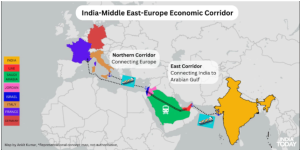
The IMEC Corridor route consists of two main components:
Goods will be transported from Indian ports to UAE and Saudi Arabian ports, where they will be transferred to rail networks that connect to Europe. This setup ensures a faster and more cost-effective alternative to traditional maritime-only routes.
The IMEC Corridor map highlights the significant ports and railway links facilitating the project. The key IMEC ports include:
The India-Middle East-Europe Economic Corridor holds immense significance for global trade and geopolitics. Some key benefits include:
[metaslider id=”5575″]
While the IMEC Corridor presents significant advantages, challenges remain:
Despite these obstacles, the IMEC Corridor is poised to become a transformative trade route, enhancing global connectivity and economic integration.
For UPSC aspirants, the IMEC Corridor UPSC topic is essential under international relations, economic development, and global trade. Key points to focus on include:
The IMEC Corridor is a groundbreaking initiative that aims to reshape global trade dynamics by connecting India, the Middle East, and Europe through a modern, efficient, and secure trade network. With strategic investments and cooperation, this project has the potential to revolutionize economic partnerships and boost global commerce. As developments unfold, the IMEC Corridor will continue to be a key focal point in international trade and geopolitics.
The IMEC Corridor follows a two-part route. The eastern segment connects India to the Middle East through maritime transport, while the northern segment links Middle Eastern countries to Europe via rail. This combination of sea and rail transport ensures faster and more cost-effective trade.
The IMEC Corridor includes India, the United Arab Emirates, Saudi Arabia, Jordan, Israel, and European nations such as Italy, France, and Germany. The United States is also involved as a supporting partner. These countries collaborate to create a seamless transport network linking Asia to Europe.
The IMEC Corridor was announced on September 9, 2023, during the G20 Summit in New Delhi. It was introduced as a major global infrastructure initiative to enhance trade and economic cooperation between South Asia, the Middle East, and Europe.
The IMEC Corridor is significant for UPSC exams as it falls under topics like international relations, economic development, and global trade. Aspirants should focus on its impact on India’s economy, its comparison with China’s Belt and Road Initiative, and the geopolitical implications of the project.

Refine your answer writing skills and elevate your UPSC preparation with personalized support and expert feedback.
Fill out the form to get started with the program or any other enquiries !






Are you dreaming of becoming an IAS officer? Then, IAShub can be your best guide. It is one of the Best IAS Coaching in Delhi. Many students who want to clear the UPSC exam join IAShub for learning. The institute gives both online and offline classes. Their teachers are experienced and helpful. They easily explain every topic. Students also get notes, tests, and tips to do well in the exam.
IAShub is in Delhi and is trusted by many UPSC students. It offers coaching for every part of the UPSC exam – Prelims, Mains, and Interview. The classes are simple and easy to understand. The teachers are experts and guide students in the right way. IAShub is also known for its helpful notes, test series, and answer-writing practice. IAShub is the best coaching in Delhi and also gives UPSC Online Classes. This helps students from any place in India to learn. The online classes are live and also recorded. So, students can watch them anytime. These classes cover the full UPSC syllabus.
Here are some important services provided by IAShub:
The UPSC Civil Services Exam has three parts:
This exam is tough, but with the right guidance, it becomes easy to manage. Students must study smart and stay regular.
IAShub supports students from the beginning to the end. It gives the right books, tests, and notes. The classes are easy to follow, and the teachers are always ready to help. Students get personal doubt sessions too. The test series and answer checking help students learn where they need to do better. Also, free study materials save time and money.
IAShub also guides students during the final stage – the interview. Experts take mock interviews and give useful tips. This full support makes IAShub one of the best IAS coaching in Delhi.